In this article
- Why prepaid pricing is back in 2026
- Pay as you go, prepaid credits, subscription: three different machines
- What credits actually change for your business
- Five traps in the credits model
- How to price a credit: a five-step method
- VAT, accounting and terms of sale
- Launching a usage-based model with PayFacile
- What's coming next
- Which model fits which business
- The takeaway
Your customers pay for a subscription they use 30 % of the time. You watch churn climb without understanding why: the product is good, the service is good, but that line on the bank statement has become hard to justify. That gap is exactly where pay as you go and its most merchant-friendly variant — prepaid credits, bought upfront and burned at the customer's own pace — are taking over.
This isn't a Silicon Valley invention. The ten-session punch card, the pack of car washes, the block of agency hours: prepaid pricing has existed in retail and services forever. What changed in 2026 is that it became a deliberate, measured pricing model — and frequently a more profitable one than a pure subscription.
Why prepaid pricing is back in 2026
Three forces are converging.
Subscription fatigue is now measurable. Market studies published through 2026 point the same way: roughly 47 % of consumers say they cancelled at least one subscription in the past year, up from about 31 % in 2024. Two reasons come up again and again: price increases and under-use — that nagging sense of paying for something "I don't use enough".
Usage-based pricing left the developer world. OpenView's research puts around 61 % of software companies using some usage-based component, up from 45 % in 2021. Chargebee's State of Recurring Revenue & Monetization 2025 report (473 US and UK leaders surveyed) found hybrid models — a recurring base plus a usage component — outperforming pure usage-based pricing on margin. On the buying side, Chargebee's consumer study (1,454 respondents) found 70 % of consumers open to paying by usage.
AI made the credit the default unit of account. Zapier prices AI steps by model tier (1x, 3x or 5x tasks per run since June 2026), and Intercom’s Fin agent charges $0.99 per resolved conversation and $9.99 per qualified lead. The "credit" has become the standard wrapper for selling variable consumption without scaring the buyer — and your customers now recognise it, consumer businesses included.
Pay as you go, prepaid credits, subscription: three different machines
They get lumped together. They don't share the same cash mechanics or the same risks.
| Model | When the customer pays | What they buy | Cash-flow effect | Main risk |
|---|---|---|---|---|
| Subscription | Fixed date, before use | Access or a periodic quota | Predictable recurring revenue | Churn driven by under-use |
| Pay as you go (postpaid) | After use, on invoice | Actual consumption | Delayed collection, collection risk | Bill shock, volatile revenue |
| Prepaid credits (pay in advance) | Before use, per pack | A store of value | Cash upfront, negative working capital | Service debt and mishandled expiry |
The key point: a prepaid credit is not revenue, it's a customer advance. You are collecting today for work you owe tomorrow. That is excellent for cash flow and, if you don't manage it, a liability that quietly compounds on your balance sheet.
In practice the winning model is rarely pure. Hybrid dominates: a subscription base for predictability, credits or packs to absorb variable demand.
What credits actually change for your business
You get paid before you deliver. A ten-session pack collected upfront funds the next two months of overhead. For a small business, that usually matters more than a point of margin.
An unused balance is a reason to come back. A customer who has already paid returns rather than waste the money. The effect is psychological, well documented, and far sturdier than the passive retention of a forgotten subscription — which eventually ends in cancellation.
You raise average order value without raising prices. Selling ten sessions at once with a 10 % discount brings in more, sooner, than hoping for ten separate purchases spread over six months.
You remove the friction of repeat buying. No payment step at every session, no chasing: the customer has already paid, they just consume.
Two realities come with it. Revenue is deferred for accounting purposes (more below), and a share of credits will never be used — breakage. Depending on the business, 5 to 15 % of sold credits typically expire unused. That is real profit, but building your economics on it is a mistake: high breakage is a symptom of a badly calibrated offer, and it always gets paid back in reputation.
Five traps in the credits model
- The credit that means nothing. If your customer can't answer "what is one credit worth?" in a single sentence, your grid has failed. A credit should map to an obvious unit of value: a session, an hour, a processed order, an appointment.
- Hidden expiry. Expiring credits is legitimate; burying it in the fine print is not. The validity period belongs on the sales page, in the confirmation email and in your terms of sale.
- Runaway service debt. Selling 200 sessions in December is great for cash — provided you can deliver them in Q1. Cap the volume you sell to the capacity you can actually produce.
- Packs cannibalising recurring revenue. Boutique fitness operators who publish their ratios target roughly 50-65 % of revenue from memberships and 15-25 % from packs; past 35 % in packs, predictability collapses. Members on auto-pay retain markedly better — on the order of 34 % better — than pack buyers.
- Flying blind. With no usage counter and no alert, you discover a customer's balance when they ask for a refund. Studios that trigger a top-up campaign at 70-80 % pack utilisation convert 30 to 45 % of pack buyers into members.
How to price a credit: a five-step method
1. Pick the unit of value. It must be countable by the customer without effort: a session, an hour on site, an article written, a parcel shipped, a ticket resolved. Avoid technical units ("tokens", "points") in consumer businesses.
2. Start from marginal cost, not market price. Work out what one delivered unit really costs you (time, subcontracting, fees), then apply your target margin. That's your floor.
3. Anchor on your single-unit price. The à la carte price stays your public reference. The pack should show a visible but reasonable saving: 10 to 30 % depending on volume. Go further and you destroy your own reference price.
4. Stop at two or three tiers. Three options invite comparison; six cause paralysis.
| Offer | Price | Price per session | Saving |
|---|---|---|---|
| Single session | €90 | €90 | — |
| 5-session pack | €425 | €85 | 6 % |
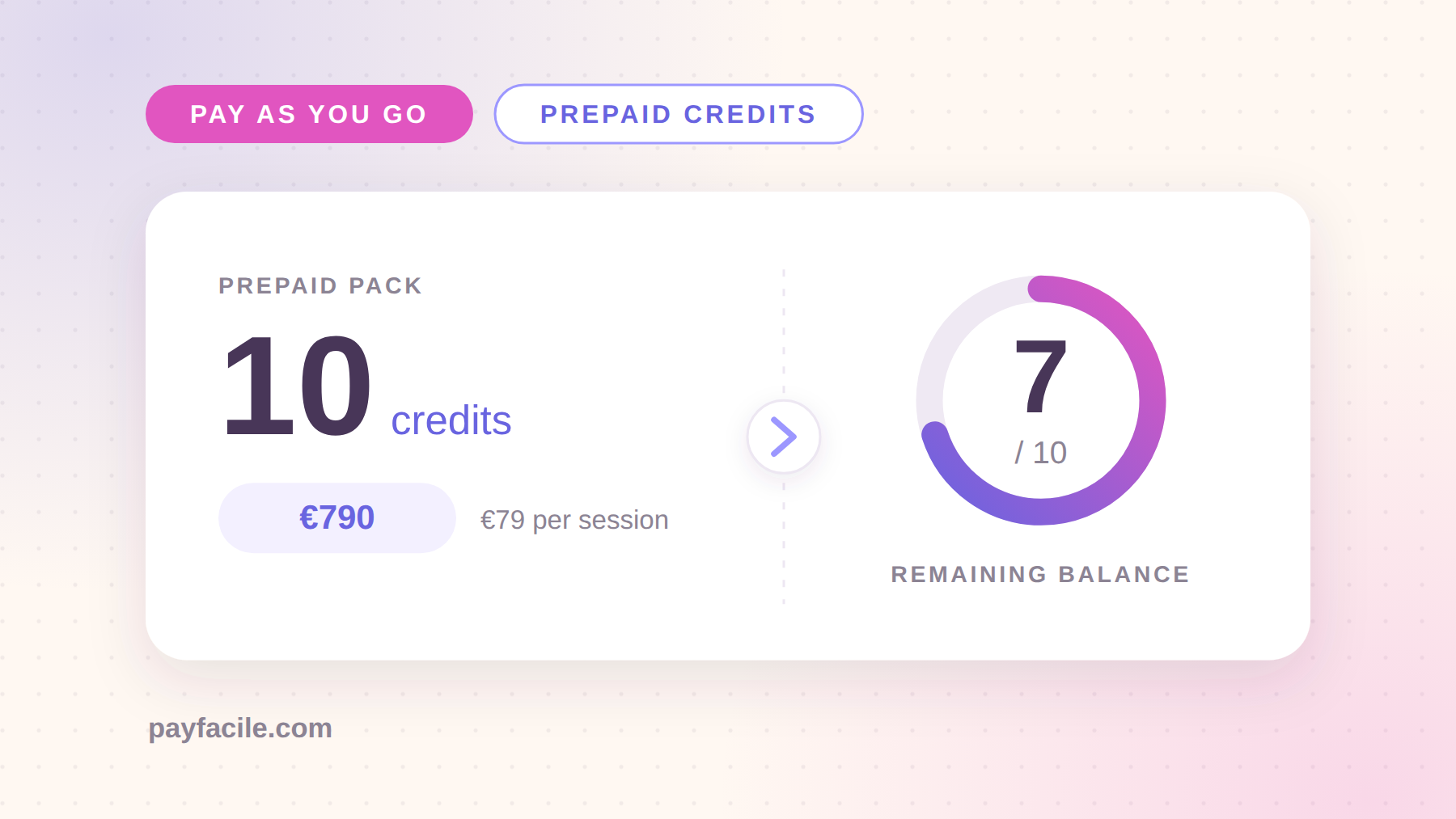
| 10-session pack | €790 | €79 | 12 % |
5. Set a validity period and a top-up trigger. Six to twelve months protects your production capacity without looking predatory. Add an automatic reminder when the balance drops below a threshold (20 % remaining): that's where repeat purchases are won.
VAT, accounting and terms of sale
Selling prepaid credits means issuing a voucher in the tax sense. Across the EU, Directive 2016/1065 (in France, article 256 ter of the Code général des impôts, in force since 1 January 2019) splits them in two:
- Single-purpose voucher (SPV): at issuance, the nature of the service, its place of taxation and the VAT rate are all known. VAT is then due when the pack is sold. A book of ten identical coaching sessions is the textbook case.
- Multi-purpose voucher (MPV): the credit can be spent on services with different rates or places of taxation. VAT only becomes due when the credit is redeemed.
This distinction drives your VAT return from the very first pack you sell — confirm your case with your accountant before launching.
On the accounting side, collecting a pack is not revenue: it is deferred revenue, a contract liability recognised as credits get consumed (the logic behind IFRS 15 and ASC 606). Your reported revenue follows delivery, not collection. If you can reliably estimate breakage from history, those standards let you recognise the expected unused portion in proportion to actual usage — an estimate that must be documented, not guessed.
Three clauses to lock down in your terms: the validity period and what happens to the remaining balance at expiry, the refund conditions (and how they interact with statutory withdrawal rights where they apply), and whether credits are transferable. One edge case: if your credits can be spent with third-party partners, you leave the world of commercial vouchers and enter payment services regulation — in France, the "limited network" exemption in article L.521-3 of the Code monétaire et financier requires notifying the regulator (ACPR) above one million euros of transactions over twelve months.
Launching a usage-based model with PayFacile
You don't need to build a billing platform to run a credits model. With PayFacile it takes a few steps:
- Create your packs as one-off products (service or digital product type). Either one product per tier, or a single product with option groups for pack sizes, so the customer picks 5, 10 or 20 units on the same page.
- Go hybrid with a subscription: any frequency (days, weeks, months, years), trial period, setup fee, deferred start and automatic expiry after N periods. The base plan carries the recurring revenue, packs absorb the peaks.
- Let the subscription carry the balance: a quota-type option turns the purchased volume into a balance attached to the customer's subscription. At checkout they pick the number of sessions or units, and that number becomes their counter.
- Draw it down from the order page: adjust the balance at any time, with a quote showing the pricing impact before you confirm, and a choice between applying the change immediately on a pro-rata basis or at the next renewal. Every movement is timestamped in the customer's activity feed.
- Collect by card (Stripe) or SEPA direct debit (GoCardless): for regular B2B top-ups, SEPA meaningfully cuts collection costs.
- Automate follow-ups with workflows: they react to events such as "New order", "Subscription renewed" or "Auto charge failed" and send the matching email — pack confirmation, top-up reminder, expiry warning.
- Add promo codes for a first top-up or a seasonal offer without touching your public price grid.
- Gate content behind an active product: pages and blog articles can be restricted to customers with a running order, which turns a pack into genuine membership status.
- Let customers self-serve: orders, invoices and payment methods are available in the customer portal without any work on your side.
Two ways to draw credits down, depending on volume. Manually, from the back office: that suits a coach, a practice or an agency burning a few units a week, and it needs no setup at all. Automatically, by connecting your business tool — booking calendar, n8n, Zapier — to your billing API keys, available in your account's integration settings: the balance decrements as each unit is delivered, hands-free.
Start manual. Automate when volume justifies it — and by then you will have real numbers on how much of a pack customers actually burn, which beats any launch-day assumption.
What's coming next
Usage-based pricing is an active build at PayFacile. Here's what's in the pipeline — and if one of these is what stands between you and a launch, tell us: it moves the order we ship them in.
- True metered billing. Today your customer buys a volume and draws it down. Soon you'll be able to invoice at the end of the period for what was actually consumed, with a unit price and, if you want one, an included allowance before charges start. That's pay as you go in the strict sense — useful when volume can't be decided upfront: support, maintenance, on-site hours, on-demand processing.
- A customer-visible balance. The counter already exists on the merchant side; it will show up in the customer portal with movement history and expiry date. Fewer support questions, more spontaneous top-ups.
- Automatic top-up. A threshold, a refill pack, a payment that fires on its own: the customer never hits zero and you never chase anyone.
- A low-balance trigger in workflows. A "balance below threshold" event to wire to an email, alongside "New order" and "Auto charge failed".
- Drawdown by API and webhook. A direct decrement route, so a booking calendar, a point-of-sale system or an internal tool can connect without an intermediate connector.
- Consumption analytics. Average pack utilisation, median time from purchase to exhaustion, share of credits expired: the three numbers that tell you whether your price grid is calibrated — and the only ones that let you manage breakage instead of absorbing it.
Which model fits which business
| Business | Recommended model | Why |
|---|---|---|
| Coach, therapist, consultant | Session packs + optional subscription | Immediate cash and commitment over the programme |
| Studio, gym | Membership-led + supporting packs | Recurring revenue carries profitability, packs capture the undecided |
| Agency, freelancer | Prepaid hour blocks (retainer) | Secures workload and avoids renegotiating every project |
| SaaS, AI tool | Base subscription + usage credits | Hybrid: predictable for you, flexible for the customer |
| Local services (laundry, car wash, delivery) | Prepaid punch-card packs | Automatic repeat purchase without a loyalty programme |
| Training, creators | Annual access or session credits | Choose between depth of commitment and low entry friction |
The takeaway
Pay as you go isn't the enemy of subscriptions — it's the on-ramp and the safety net. Prepaid credits give you subscription-grade cash without the commitment that scares buyers away, as long as you define a clear unit, an honest validity period and an automatic reminder before the balance runs out. Start simple: one unit price, two pack tiers, one expiry date. Adjust once you have real numbers.
Build your first prepaid pack on PayFacile in minutes and get paid before you deliver. And if the piece you're missing is on the list above, write to us: our merchants' usage-based models decide the order we ship them in.
See how PayFacile can help
Frequently Asked Questions
- What is the difference between pay as you go and prepaid credits?
- Under pay as you go, the customer consumes first and is invoiced for actual usage afterwards. With prepaid credits, they buy a pack upfront and draw it down over time. The first maximises flexibility but delays your collection; the second pays you in advance and creates a built-in reason to return.
- Is VAT due when prepaid credits are sold?
- It depends on the type of voucher. If the service, its place of taxation and its VAT rate are known at issuance, it is a single-purpose voucher and VAT is due when the pack is sold. If credits can be spent on services with different rates or locations, VAT is only due on redemption.
- Can prepaid credits expire?
- Yes, provided the validity period is stated clearly before purchase, repeated in the confirmation email and written into your terms of sale. Six to twelve months is common in service businesses. Hidden expiry invites disputes, chargebacks and refund demands, and costs far more than the breakage it earns.
- Prepaid credits or subscription: which makes more money?
- Subscriptions produce more predictable revenue and retain better over time; packs collect faster and convert hesitant buyers more easily. The strongest operators run both, keeping most revenue recurring while holding packs to a controlled share of roughly 15 to 25 %.
- How do I sell prepaid credits without building software?
- Create your packs as products, add a quota-type option so the balance sits on the customer's subscription, then draw it down from the order page or automatically through your API keys. Selling, invoicing, the counter itself and the reminder emails are all covered without development work.
Increase Your Sales Potential
Automate and grow your e-commerce business with ease.