In this article
- Are Gumroad and Payhip available in French?
- Two opposite models: Gumroad resells, Payhip routes the money to you
- Who collects the VAT on your sales?
- Franchise en base and the €10,000 threshold: what stays with you
- Invoices: on both tools, the buyer generates one from the receipt
- Payment methods: SEPA Direct Debit is listed on neither
- Fees, dollars and payouts
- The questions to ask before you choose
- And PayFacile?
Are Gumroad and Payhip available in French?
Up to date as of 8 November 2026.
Payhip, partly: your store and checkout can be shown in French, but your dashboard stays in English. Gumroad: we found nothing. This guide is for sellers established in France, and it’s based on Gumroad’s and Payhip’s public pages, linked throughout. These tools change often: check their pages before you choose.
On Payhip, you pick your store’s language from 15, French included. Its help page is clear about the limit: “This will only change the customer-facing side of your store to that language. The dashboard will still be in English.” Each store gets one language and one currency. The default currency is USD, and EUR is on the list. Some text you translate yourself: navigation links, collection names, custom receipt subject lines, and your product titles and descriptions.
As of 8 November 2026, we found no French-language option on Gumroad’s public pages or in its help center. Its terms of use are written in English, under an express clause. If language matters to you, check inside your own account before you commit.
That clause is article 27.9 of Gumroad’s terms, and Gumroad wrote it in French as well: « Les parties confirment leur volonté expresse à ce que la présente convention, ainsi que tout document ou avis s’y rapportant, soit en anglais » (the parties expressly want the agreement, and every related document or notice, to be in English).
Both offer email support with no phone line, and neither says which languages its support team works in (Gumroad, Payhip). Gumroad says it answers 97.7% of requests within an hour; Payhip says it aims to reply within 24 hours.
A bit of manual translation is something you can live with. The question that weighs more for a seller based in France comes next: who legally sells your product to the buyer?
Two opposite models: Gumroad resells, Payhip routes the money to you
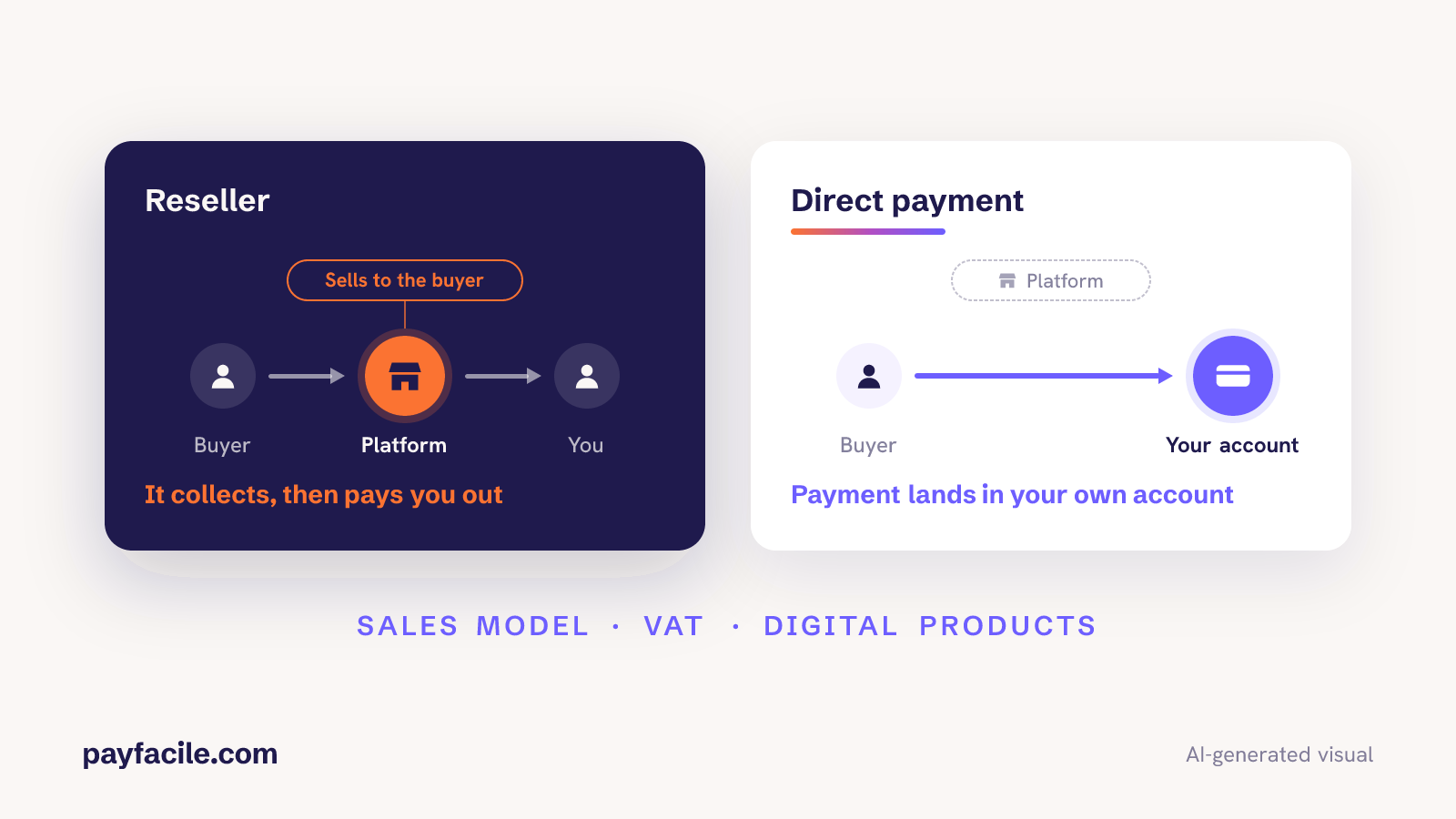
Gumroad buys and resells. Article 6.1 of its terms of use: “You hereby appoint Gumroad as your non-exclusive reseller”, and “Gumroad is the merchant of record for the resale of your Products to the Buyers”. Merchant of record means that, as far as the buyer is concerned, the seller is Gumroad. The same clause bars you from issuing an invoice to a buyer or asking a buyer for payment.
What follows, still under those terms. Gumroad “reserves the right to set the price”, and you supply a suggested price (6.3). What you receive is called the “Supplier Fee”: the price the buyer paid, minus Gumroad’s fee, minus taxes and other amounts due (6.4). For indirect taxes, VAT included, “Gumroad will be treated as the seller of your Products” (6.2 e). Disputes with Gumroad go to arbitration in California (article 25).
Payhip works the other way round. You connect your own payment account (Stripe or PayPal, from France), and according to its help pages “the payment is processed and sent directly to your connected payment processor at the time of purchase”. Payhip adds that it “does not hold funds and cannot issue refunds directly”. You set your own refund policy, and buyers come to you (help article 374, help article 281). Payhip Limited is a company incorporated in England and Wales, and its terms are governed by English law.
Both models are defensible. With Gumroad, you hand over collection and VAT, you don’t invoice the buyer, and you accept that someone else sets the frame, price included. With Payhip, the money goes through your own account, and you’re left with one VAT question to put to Payhip (see below). Our view: choose the model before the tool. The language on the screen comes after.
Who collects the VAT on your sales?
Gumroad spells it out on its VAT help page: “Gumroad handles VAT on behalf of creators for all digital product sales in the EU and the UK.” It collects the VAT and remits it. You can’t make prices VAT-inclusive or choose not to charge VAT; to that question the page answers “No.” For a physical product shipped within the EU, Gumroad adds no VAT at checkout. And since 1 January 2025, according to its pricing page and its sales tax help page, Gumroad is the merchant of record for all sales, in every country.
For context, here’s the EU rule. Implementing Regulation (EU) No 1042/2013 inserted an article 9a into Regulation 282/2011, applicable since 1 January 2015. When an electronic service is supplied through an interface or a marketplace, the platform is presumed to act in its own name, unless the provider is explicitly named as the supplier in the contract, the invoice and the receipt. A platform that authorises the charge to the customer, delivers the service or sets the general terms and conditions can’t name anyone else as the supplier.
On VAT, Payhip’s dedicated page says: “we act as your reseller which means we’re 100% responsible for digital EU/UK VAT”. Its help pages also say the buyer’s payment is sent directly to your Stripe or PayPal account and that “Payhip does not hold funds”. They do not say under which VAT number Payhip reports these sales, or in whose name the buyer’s invoice is issued. Before you choose, ask Payhip both questions in writing and show the answer to your accountant.
On Payhip, this setting is on by default, and you can untick it in the Taxes tab to deal with VAT yourself. Payhip gives its own worked example for a customer in France (help article 127): a $10 price with VAT added, so the buyer pays $12; Payhip takes 5% of $10 plus the $2 of VAT, and the seller receives $9.50, minus PayPal fees.
Franchise en base and the €10,000 threshold: what stays with you
A platform collecting VAT on your sales doesn’t settle your whole tax position in France. Two sets of rules stay with you, all the more when the money comes into your own account.
The franchise en base de TVA, France’s VAT exemption for small businesses (article 293 B of the Code général des impôts). As of 8 November 2026, its thresholds are €37,500 of turnover in the previous year and €41,250 in the current year for services, and €85,000 and €93,500 for sales of goods (BOFiP, service-public). Go over the first threshold and VAT applies from the following 1 January. Go over the higher one and the franchise ends from the first day you exceed it. The single €25,000 threshold announced at one point has been dropped. As service-public puts it: « Pour l’année 2026, les seuils de franchise en base de TVA française applicables restent inchangés » (for 2026, the French thresholds are unchanged).
Digital products and online courses sold over the internet are electronically supplied services, so they count as services. The BOFiP doesn’t say so in as many words for these services, so ask your accountant (expert-comptable) to confirm which threshold applies to your sales.
Under the franchise, your invoices carry the line « TVA non applicable, article 293 B du CGI », and no VAT may appear on them: VAT you invoice is VAT you owe. So check one setting before you sell: the tool mustn’t charge VAT in your name. On Payhip, EU VAT handling is on by default and sits in the Taxes tab; have your accountant confirm what it means for a seller under the franchise. One more date: on 1 January 2027, French VAT law moves from the Code général des impôts to the code des impositions sur les biens et services. Article numbers change, 293 B included, and the obligations stay the same.
The €10,000 threshold for sales to consumers elsewhere in the EU. It’s €10,000 excluding VAT per year, measured over the current and previous calendar years, across all your cross-border electronic services and intra-EU distance sales of goods. Below it, in the French tax authority’s words, « la TVA reste due dans l’État membre d’établissement du prestataire »: VAT stays due where you’re established, so in France, with the franchise if you qualify (impots.gouv.fr). Above it, you charge the VAT of the buyer’s country and declare it through the guichet unique (the EU One-Stop Shop, OSS) on impots.gouv.fr, which is open to every taxable business whatever its VAT regime.
What happens to the French franchise on EU sales above that threshold, we haven’t verified on an official source. It’s a question for your accountant, and it’s in the list below.
Invoices: on both tools, the buyer generates one from the receipt
Gumroad emails a receipt. The buyer generates the invoice from that receipt by entering a name and address (help article 194). An EU business can add its VAT number there and get the VAT refunded (help article 200). And “Gumroad Support doesn’t have the capability to change or adjust invoices.” Gumroad’s pages don’t say in whose name the invoice is issued, and its terms bar you from issuing one.
On Payhip, the buyer gets a receipt showing your email address and generates a PDF invoice from it, with their name, address and VAT number (help article 119, help article 158). Payhip notes: “The information shown on the invoice is based on what the seller has provided in their account.” Its pages don’t say in whose name the invoice is issued.
What about French e-invoicing? For your sales to consumers you don’t issue e-invoices: those sales fall under transaction e-reporting, plus payment e-reporting for services, which small businesses and micro-entrepreneurs must start by 1 September 2027 at the latest. Every business in France, micro-entrepreneurs under the franchise included, must already be able to receive e-invoices through a plateforme agréée (an approved e-invoicing platform) since 1 September 2026 (impots.gouv.fr). E-reporting also covers transactions with operators established abroad; whether it covers your sales to a reseller like Gumroad is your accountant’s call.
Payment methods: SEPA Direct Debit is listed on neither
On Gumroad, buyers pay by card (Visa, Mastercard, Amex, Discover, Maestro, Diners), Apple Pay, Google Pay or PayPal, and by local methods such as UPI in India (help article 191, help article 282). PayPal only shows up if you’ve turned on PayPal Connect, which works from France; your PayPal sales then reach your PayPal account at the time of sale (help article 275). Stripe Connect no longer takes new accounts, except from Brazil (help article 330). Bank debit exists as US ACH, for US customers only and off by default (help article 351). Gumroad doesn’t list SEPA Direct Debit.
On Payhip, payment methods depend on the processor you connect. Through Stripe, Payhip names methods such as cards, Apple Pay, Google Pay, Link, iDEAL, Bancontact, Klarna and Alma (help article 65); through PayPal, PayPal balance, cards and bank account payments where available (help article 64). Payhip doesn’t mention SEPA Direct Debit in the methods it lists.
Both sell subscriptions. On Payhip (bundles, memberships, courses, coaching) they work with Stripe only, weekly, monthly, quarterly or yearly, with an optional free trial (help article 303). On Gumroad, memberships run monthly, quarterly, every six months or yearly (help article 278).
If you sell subscriptions to European customers and SEPA Direct Debit matters to you, ask the tool before you sign up. For a monthly subscription sold in France, it’s the first thing we’d check. We compare the two methods in our article on SEPA Direct Debit and card payments.
Fees, dollars and payouts
Gumroad. According to its fees help page, a direct sale costs 10% + $0.50, plus 2.9% + $0.30 for card processing, with PayPal’s fees on top for a PayPal payment. A sale that comes through its Discover marketplace costs 30%, processing included. There’s no monthly subscription. Once you pass $20,000 of paid sales in a month, new direct sales that month drop to 5% + $0.50. Watch out: the pricing page shows “10% + $0.50” and the 30% Discover rate without mentioning card processing. Do your sums from the help page.
One-off card purchases are charged in the local currency offered at checkout, euro included. Beyond that, “All other transactions are processed in USD”, which covers subscriptions and other purchases (help article 46). A subscription’s display currency can’t be changed once it’s created. Gumroad also warns that customers outside the US may pay an international purchase fee, depending on their card company.
For France, Gumroad pays out in euros by bank transfer, from $100 or the equivalent, weekly, monthly or quarterly (help article 13). Each sale waits at least 7 days. Euro accounts are paid on Wednesdays, for sales up to the previous Friday (UTC), and the transfer takes 2 to 7 business days depending on the country. Currency is converted at the rate on the day of the sale, not the payout day, and Gumroad says “These are typically mid-market rates.” Gumroad doesn’t announce any conversion fee on bank payouts.
Payhip. According to its pricing page and billing help page, there are three plans with the same features: Free Forever at $0 a month plus 5% per sale, Plus at $29 a month plus 2%, and Pro at $99 a month with 0%. Stripe or PayPal fees come on top of all three. Payhip pays you nothing itself: the money is already in your Stripe account, which transfers to your bank daily by default, or in your PayPal account, which you withdraw from manually by default (help article 65, help article 64).
What stays annoying on both: fees and plans priced in dollars. If you pay them from a euro account, what the conversion costs you depends on your bank.
The questions to ask before you choose
If you sell to consumers in France, ask the platform these questions in writing, and ask your adviser:
- Who legally sells to the buyer: you, or the platform? As a rule, whoever sells owes the pre-purchase information, the terms of sale and the handling of withdrawal.
- For digital content delivered at once (a file, a recorded course), does the checkout ask the buyer for express consent and a waiver of the withdrawal right, and is a confirmation sent afterwards? Without that, the buyer generally keeps 14 days to withdraw.
- Are the terms of sale the buyer sees in French?
- Is the price shown to the buyer in euros, tax included?
- If the platform resells your product, who answers the buyer on complaints, refunds or disputes, and under which law?
If you’re leaning towards Payhip, add two written questions: under which VAT number does Payhip report your sales, and in whose name is the buyer’s invoice issued?
Then, with your accountant:
- When the platform resells your product, what do you declare as turnover to the Urssaf and the tax office: the price the buyer paid excluding tax, or the amount the platform pays you?
- Your sale to a reseller established outside the EU, such as Gumroad, Inc. in the United States: what place of supply, what wording on the invoice (or what self-billing), and what e-reporting?
- Which franchise threshold applies to your digital products and online courses?
- If your sales to consumers in other EU countries go over €10,000 excluding VAT a year, what happens to your franchise on those sales?
And PayFacile?
With PayFacile, you remain the seller: you connect your own Stripe account (card, SEPA Direct Debit) or GoCardless account (SEPA Direct Debit), and the money arrives in that account, then in your bank. An invoice is generated for every payment. The interface, documentation and support are in French. The flip side: VAT and your terms of sale stay with you.
Our prices are on our pricing page.
See how PayFacile can help
Frequently Asked Questions
- Is Gumroad available in French?
- As of 8 November 2026, we found no French-language option on Gumroad’s public pages or in its help center. Its terms of use are written in English, under an express clause (article 27.9). If language matters to you, check inside your own account before you commit.
- Can a Payhip store be in French?
- Yes, on the buyer’s side. As of 8 November 2026, Payhip offers 15 store languages, French included, but its help page says the dashboard stays in English. Each store has one language and one currency (USD by default, EUR available), and product titles and descriptions are translated by hand.
- Who collects the VAT on a Gumroad sale?
- Gumroad. According to its terms of use and its VAT help page, read on 8 November 2026, Gumroad resells your product in its own name as merchant of record, and collects and remits VAT on digital product sales in the EU and the UK. You can’t make prices VAT-inclusive. How your own sale to Gumroad is taxed in France is a question for your accountant.
- Does Payhip collect VAT on the seller’s behalf?
- By default, for EU and UK VAT on digital products, according to its pages read on 8 November 2026: Payhip says it acts as your reseller and reports the VAT it collects each quarter. You can untick the setting in the Taxes tab. Its pages also say the payment goes directly to the seller’s Stripe or PayPal account, without saying under which VAT number Payhip reports these sales or in whose name the invoice is issued: ask Payhip in writing.
- Do Gumroad or Payhip offer SEPA Direct Debit?
- As of 8 November 2026, Gumroad doesn’t list SEPA Direct Debit among its payment methods (it offers ACH, for US customers only), and Payhip doesn’t mention it in the methods it lists through Stripe or PayPal. If you need it for subscriptions, ask the tool before you choose.
- What VAT threshold applies to digital sales to EU consumers from France?
- As of 8 November 2026, according to impots.gouv.fr: €10,000 excluding VAT per year, over the current and previous calendar years, across all cross-border electronic services and intra-EU distance sales of goods to consumers. Below it, VAT stays due in France; above it, you charge the buyer’s country’s VAT and declare it through the guichet unique (the EU One-Stop Shop).
Increase Your Sales Potential
Automate and grow your e-commerce business with ease.