In this article
- Did the 3 November vote suspend e-invoicing in France?
- What did French amendment I-3426 provide?
- Why did amendment I-3426 fall on 4 November?
- Can the small-business exemption come back in the French Sénat?
- Which French e-invoicing deadlines apply today?
- What fines do you risk under the French e-invoicing rules?
- VAT-exempt micro-entrepreneur in France: does e-invoicing apply to you?
- Selling to private individuals in France: e-invoice or e-reporting?
- What should you do now about French e-invoicing?
- Is your invoicing tool connected to an approved platform?
Did the 3 November vote suspend e-invoicing in France?
Up to date as of 6 November 2026, with the Sénat section updated on 23 November 2026.
No. On Tuesday 3 November 2026, at 11:38 pm, French MPs adopted amendment no. I-3426, which took SMEs and micro-entreprises out of the reform. The next day, the Assemblée nationale (the lower house of the French Parliament) rejected the first part of the 2027 budget bill, the projet de loi de finances pour 2027 (PLF 2027), by 0 votes to 458 (public vote no. 9759). The chair of the sitting spelled out the consequence: “Since the Assemblée has not adopted its first part, the 2027 budget bill as a whole is considered rejected” (record of the 4 November sitting).
This is French law. It applies to businesses established in France, and it is not an EU-wide or UK rule.
So the exemption only ever lived in a text that was rejected the next day. The articles announcing a suspension are describing that text. For you, nothing changes.
What did French amendment I-3426 provide?
Tabled on 10 October 2026 by Mathilde Hignet and the MPs of the La France insoumise group (LFI-NFP), it was adopted by 101 votes to 74, with 5 abstentions (public vote no. 9643). The finance committee (general rapporteur Philippe Juvin) and the Government (minister David Amiel) had both given an unfavourable opinion.
The text took micro-entreprises and SMEs out of the whole reform, issuing, receiving and e-reporting included, along with farmers. The SME definition used is the one in the 2008 French economy modernisation act (loi de modernisation de l’économie), so very small businesses, known in France as TPE, and micro-entrepreneurs were covered too. Large companies and mid-sized companies (ETI) remained subject to it.
One point has been badly reported: the text that was voted contains neither an end date nor a condition. The idea of a moratorium until a public invoicing portal exists appears only in the exposé sommaire, the authors’ statement of intent, which has no legal force. Many articles presented it as a condition written into the law. That is wrong.
Why did amendment I-3426 fall on 4 November?
On 4 November, the Assemblée rejected the first part of the bill, the revenue part, which contained the amendment. The second part, on spending, was not examined, and the bill is recorded as “rejected by the Assemblée nationale” (Assemblée nationale file, Sénat file).
The Sénat (the upper house) will therefore examine the bill as the Government tabled it on 1 October 2026: its agenda lists the « projet de loi de finances pour 2027 (A.N., n° 3210) » (Sénat agenda). The amendments adopted by the MPs, I-3426 included, aren’t in it.
One detail misleads people who check: the amendment’s page still shows « Adopté (mardi 3 novembre 2026) » (adopted, Tuesday 3 November 2026). That’s normal, because an amendment’s outcome isn’t rewritten after the bill is rejected. This line does not prove that the exemption stands.
Can the small-business exemption come back in the French Sénat?
It’s possible, and some senators are asking for it. The deadline for tabling amendments on the first part closed on Thursday 19 November 2026 at 11 am. In the list published by the Sénat, reread on the morning of 23 November 2026, 25 amendments concern the obligations of the reform. Two others were withdrawn before the sitting. All of them carry the mention « En attente de recevabilité financière » (awaiting the financial admissibility check): on that date, none had been voted on. Nothing is suspended.
They fall into four groups:
- Taking micro-entreprises, and sometimes SMEs, out of the whole reform. Amendment no. I-2737, tabled on 19 November by Mr Amard, repeats the mechanism of I-3426: micro-entreprises, SMEs and farmers. Amendment no. I-678, tabled on 17 November by Mr Salmon, Ms Senée and other senators, goes less far: SMEs are no longer in it, and it only covers micro-entreprises and farmers. If your business is an SME without being a micro-entreprise or a farm, only I-2737 would take you out of the reform. In both cases, as with I-3426, the moratorium the authors mention sits in their statement of intent, not in the text. Amendment I-1088, which went the same way as I-678, was withdrawn.
- Taking businesses under the franchise en base de TVA out of the reform. The franchise en base is the French VAT exemption scheme for small businesses. Amendment no. I-1385, from Ms Pantel, covers issuing, receiving and e-reporting, from 1 January 2027, with the option to join voluntarily.
- Sparing customers under the franchise en base, or VAT-exempt customers, from receiving their invoices through an approved platform (plateforme agréée). Eleven amendments, including amendment no. I-101 from Mr Coste, take up the idea of I-1729 and I-2894, adopted on 3 November in the Assemblée: the supplier would transmit the data to the tax authority. One of them only covers VAT-exempt customers.
- Setting thresholds. Eleven amendments would take certain transactions out of the obligation, with the supplier transmitting their data to the tax authority: a transaction of €250 or less including VAT (€150 including VAT in one of them), a party whose turnover excluding VAT does not exceed €150,000 or €85,000, or a party with fewer than 250 employees. That last threshold, in amendment no. I-873 from Mr Delahaye, looks only at headcount: any transaction where one of the parties has fewer than 250 employees would leave the obligation, whatever its turnover.
The finance committee examines these amendments on the morning of Monday 23 November, and the sitting resumes the same day. Senators debate the articles of the first part until Saturday 28 November, perhaps the 29th, then vote on that part. The vote on the whole bill is scheduled for Wednesday 9 December 2026 (Sénat agenda).
Even once adopted by the Sénat, an amendment is not yet law:
- The bill then goes to a commission mixte paritaire (a joint committee of both houses), whose date has not been set. The measure can be kept, changed or dropped there. If that committee fails, each house reads the bill again, and the Assemblée nationale then has the last word in a final reading (lecture définitive).
- In the Assemblée, the Government can force the bill through under article 49.3 of the French Constitution, keeping the measure or dropping it. It opposed I-3426, I-1729 and I-2894 in the chamber on 3 November. Its position in the Sénat isn’t known yet.
Even in the most favourable case, an exemption would only apply once the 2027 budget act (loi de finances pour 2027) is promulgated, at the end of December 2026 at the earliest. The 2026 budget act was not promulgated until 19 February 2026.
Our view: counting on this exemption so you can wait is a bad bet. Receiving e-invoices is mandatory today, not when a future budget is promulgated. If the exemption comes back, you’ll have prepared too early. If it doesn’t, you’ll be ahead on a deadline that falls in less than ten months.
Which French e-invoicing deadlines apply today?
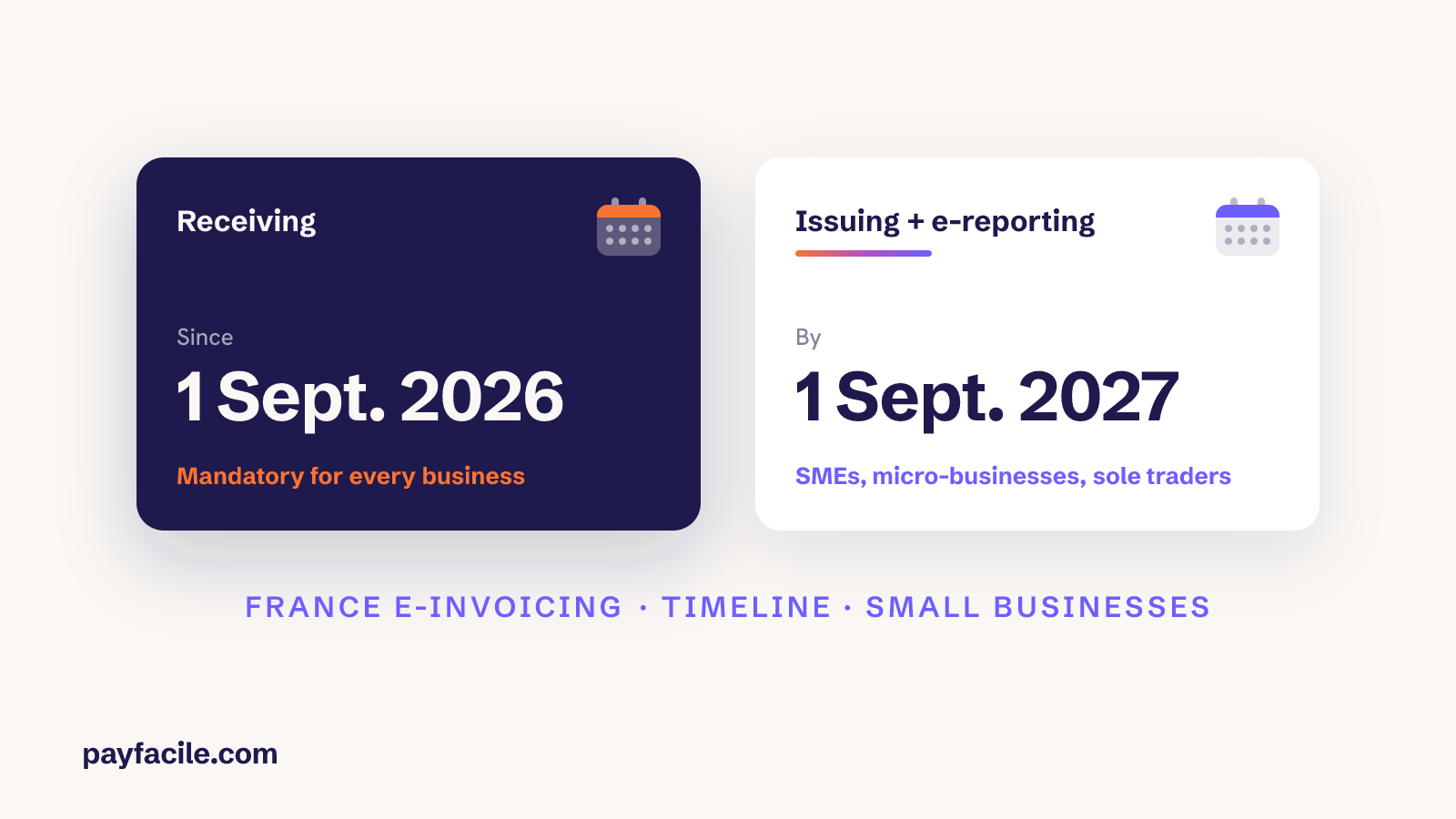
- Since 1 September 2026: every business, whatever its size, must be able to receive electronic invoices through an approved platform. Large and mid-sized companies already issue them.
- By 1 September 2027 at the latest: SMEs, very small businesses and micro-entreprises issue their invoices in electronic format and start e-reporting.
The French tax authority’s page, last modified on 26 May 2026, says it plainly: “small and micro-businesses (this includes auto-entrepreneurs) will have until 1 September 2027 to issue their invoices electronically. Transmitting data to the tax authority (e-reporting) follows the same timeline” (impots.gouv.fr). In French, the line reads « les petites et micro-entreprises (cela concerne les auto-entrepreneurs) auront jusqu’au 1er septembre 2027 pour émettre électroniquement leurs factures ». The DGFiP FAQ (the DGFiP is France’s tax and public finances directorate), in its version of 1 September 2026, gives the same dates.
You can issue electronic invoices before 2027. And if a supplier already sends you an electronic invoice, you must accept it, even if their own obligation to issue hasn’t started.
These dates are set in article 26, III, of the amending finance act of 16 August 2022, the loi de finances rectificative (DGFiP reference documents). It is the very paragraph amendment I-3426 set out to add to.
What fines do you risk under the French e-invoicing rules?
The amounts come from article 123 of the 2026 budget act, summarised by Service Public, the French government’s information site for businesses.
- No approved platform to receive your invoices. This is the obligation already in force. First a formal notice to comply within 3 months, then €500, a new 3-month formal notice, then €1,000, and another €1,000 for every 3-month period without putting things right.
- An invoice not issued in electronic format, once your obligation has started: €50 per invoice, capped at €15,000 per calendar year.
- E-reporting not transmitted: €500 per transmission, capped at €15,000 per year.
The article of the French tax code that penalises e-reporting allows some leniency: no fine for a first offence committed in the current calendar year or the three previous ones, if you put it right of your own accord or within 30 days of a first request from the tax authority.
VAT-exempt micro-entrepreneur in France: does e-invoicing apply to you?
Yes, for receiving, since 1 September 2026. The DGFiP leaflet for micro-entreprises (May 2026) is clear: “If you are subject to VAT but not liable to pay it under article 293 B of the Code général des impôts, you are also covered by the reform.” In French: « Si vous êtes assujetti non redevable de la TVA au titre de l’article 293 B du Code général des impôts, vous êtes également concerné par la réforme ».
Issuing and e-reporting arrive on the same date as for other very small businesses, 1 September 2027 at the latest. Under the franchise en base, e-reporting happens every two months, for transactions as well as payments (DGFiP FAQ).
In the chamber on 3 November, David Amiel restated it: “Electronic invoicing applies to everyone subject to VAT, from the very first euro. Some are subject to it even though they benefit from a franchise en base.”
That same evening, MPs had adopted a second text, the identical amendments I-1729 (Philippe Gosselin) and I-2894 (Vincent Rolland), by 74 votes to 70. It only targeted businesses under the franchise as customers: from 1 January 2027, their suppliers would no longer have had to send them invoices through an approved platform. Their own issuing and e-reporting weren’t affected. It fell on 4 November, like I-3426.
Selling to private individuals in France: e-invoice or e-reporting?
Your subscriptions, courses or coaching sessions sold to private individuals don’t give rise to an electronic invoice. These sales fall under transaction e-reporting: you transmit the total amount of your sales per day, over a period (DGFiP FAQ, questions 1.1 and 10.1).
For services where VAT becomes due when you are paid, payment e-reporting comes on top. If you opted to pay VAT on invoicing (the option known as TVA sur les débits), you have no payment data to transmit.
If your customer is an association that is not subject to VAT, the sale falls under your e-reporting, as for a private individual. If you are yourself an association subject to VAT, you follow the timeline for your size. Beyond that, ask your expert-comptable (chartered accountant).
Selling only to private individuals doesn’t exempt you from receiving: every business has been subject to it since 1 September 2026.
What should you do now about French e-invoicing?
None of what follows waits for the Sénat vote.
- Choose at least one approved platform to receive your invoices, sign the agreement with it and designate it in the directory (l’annuaire). The DGFiP FAQ is blunt: “You must have chosen an approved platform, at least to receive your suppliers’ invoices” (« Vous devez avoir choisi une plateforme agréée, au moins pour recevoir les factures de vos fournisseurs »).
- Don’t look for the final choice. One platform or several, the same as your suppliers’ or a different one: you can switch at any time.
- Ask your current software first. The tax authority advises contacting your software vendor “to find out where it stands on the reform, or whether it has already connected to an approved platform” (impots.gouv.fr). No software? Compare the offers: “Some offer a free core set of services”, notes the DGFiP leaflet.
- Start from the official list of approved platforms, on impots.gouv.fr: the « je passe à la facturation électronique » section (switching to e-invoicing), then « je consulte la liste des plateformes agréées » (see the list of approved platforms).
- Prepare for issuing on 1 September 2027. Four new details become mandatory when you issue: the customer’s SIREN (company registration number), the category of the transaction, the option for VAT on invoicing, and the delivery address if it differs. A “plain PDF” invoice sent by email will no longer be compliant. To go through your sales point by point, follow our 2027 e-invoicing checklist.
- Check how often you’ll have to e-report: every two months under the franchise en base, three times a month under the monthly régime réel normal (the standard VAT regime).
- For help, the DGFiP points to the CCI (chambers of commerce and industry), the chambers of trades and of agriculture, software vendors, trade federations, chartered accountants and banks.
Is your invoicing tool connected to an approved platform?
Ask the vendor of your invoicing tool this week, and insist on a precise answer: which platform, for which invoices, from when. If the answer stays vague, sort out your receiving separately, since it’s already due.
If you sell with PayFacile, here’s our answer: your invoices are generated automatically. The Factur-X format and transmission through an approved platform are planned, with no date, because that part depends on an outside partner.
See how PayFacile can help
Frequently Asked Questions
- Is e-invoicing suspended for very small businesses in France?
- No. Amendment I-3426, adopted by French MPs on 3 November 2026, fell on 4 November when the Assemblée nationale rejected the 2027 budget bill. As of 23 November 2026, receiving electronic invoices is mandatory for every business in France, and issuing them arrives by 1 September 2027 at the latest for SMEs, very small businesses (TPE) and micro-entreprises. In the French Sénat, amendments on the same subject have been tabled, including one that repeats the 3 November amendment; none has been voted on yet.
- Does a VAT-exempt micro-entrepreneur in France have to switch to e-invoicing?
- Yes, according to the DGFiP, the French tax administration: a micro-entrepreneur under the franchise en base de TVA has had to receive e-invoices since 1 September 2026, and must issue them and start e-reporting by 1 September 2027 at the latest, with e-reporting every two months.
- What is the fine in France for having no approved platform to receive invoices?
- After a 3-month formal notice, the fine is €500. A new 3-month formal notice follows, then €1,000, and another €1,000 for every 3-month period without putting things right (article 123 of the French 2026 budget act, the loi de finances pour 2026).
Increase Your Sales Potential
Automate and grow your e-commerce business with ease.