In this article
30 days by default, 60 at most: payment terms between businesses in France
As of 23 November 2026.
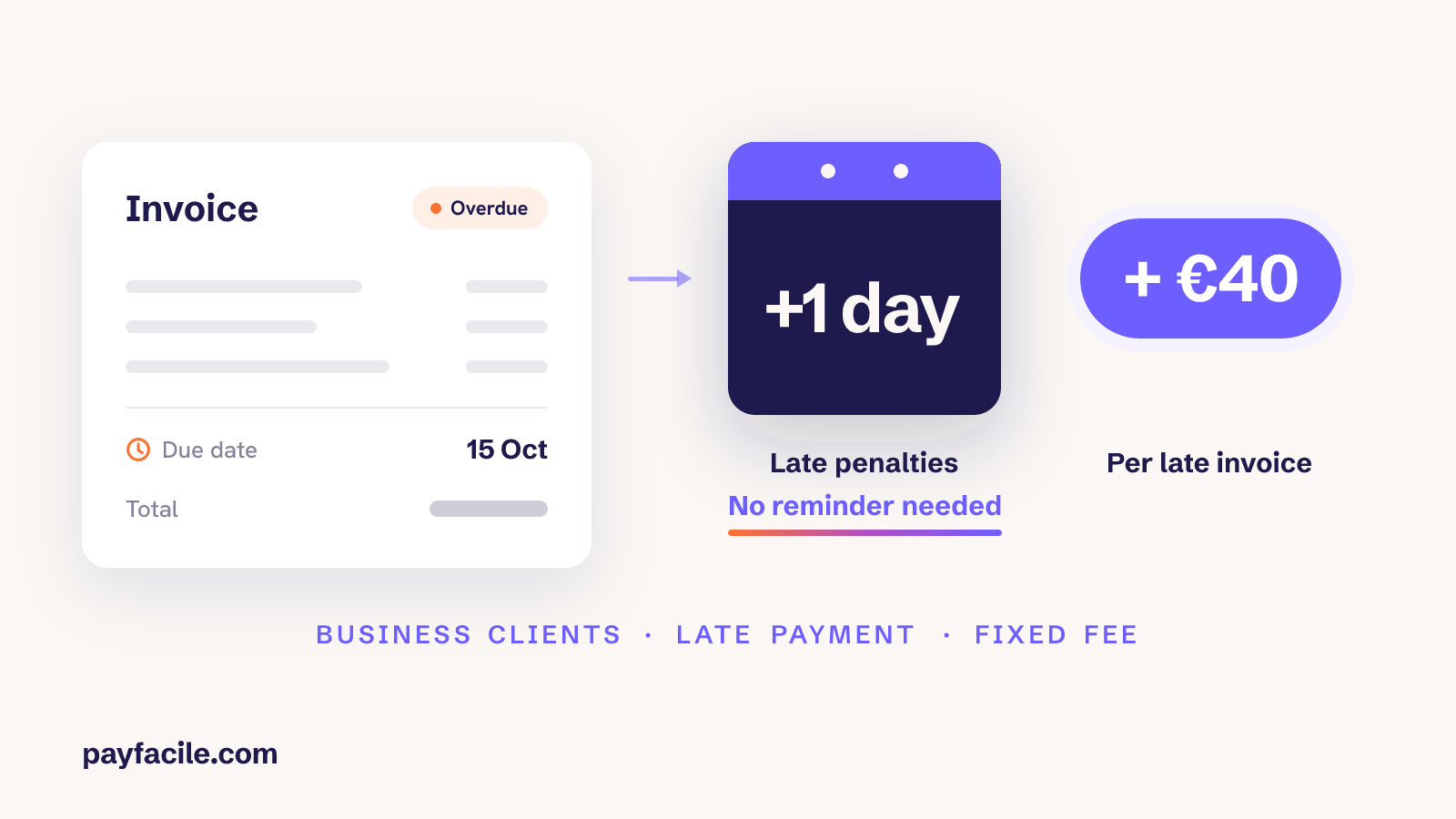
Your business client hasn’t paid by the date on your invoice. From the next day, they owe you late payment penalties, and you don’t have to chase them or send a formal notice first: 12.40% a year until 31 December 2026, plus a €40 fee for that invoice. These are French rules, set by the Code de commerce, and the figures in this guide are the ones published by Service Public, the French government’s official information site. The rules only work for you if your payment term is right and your invoice states it.
If you haven’t agreed anything with your client, the term is 30 days from receipt of the goods or completion of the service (Service Public, sheet F23211, in French). You can agree a longer term, in your conditions générales de vente (CGV, your terms of sale) or directly with the client, within one of two limits:
- 60 days from the date the invoice is issued;
- 45 days end of month (« 45 jours fin de mois ») from that same date.
For a periodic invoice, the cap is 45 days from the date it’s issued.
“45 days end of month” can be worked out two ways, and you and your client pick one. Service Public uses an invoice issued on 1 August 2026:
- end of the month of issue, then 45 days: payment due by 15 October 2026;
- 45 days after issue, then the end of that month: payment due by 30 September 2026.
Two weeks apart, on the same invoice. Our advice: fix the method in your CGV and print the resulting date on every invoice. It’s the first payment detail the invoice must carry anyway, and penalties start the day after it.
A few sectors have their own caps. In road haulage, vehicle hire, freight forwarding and customs brokerage, it’s 30 days at most from the invoice date. Some agricultural and food products, exports outside the EU and a handful of trades (toys, jewellery, winter sports gear, leather, farm machinery) have their own regimes too.
Are you a micro-entrepreneur? Nothing changes. The micro-entrepreneur version of the sheet gives exactly the same terms, rates, fee and invoice wording.
These caps come with fines. Breaking the payment term rules is punished by an administrative fine imposed by the DGCCRF, France’s consumer and competition authority: up to €75,000 for a sole trader and €2 million for a company, doubled for a repeat breach within two years. The fine is published on the authority’s website and in a legal notices publication (French Senate report no. 376).
A €1,200 invoice paid two months late: the €40 fee outweighs the penalties
The default penalty rate is the European Central Bank’s refinancing rate plus 10 points. Service Public says which ECB rate: the one in force on 1 January for the first half of the year, and on 1 July for the second. On 1 July 2026 it stood at 2.40% (ECB, policy rates), so the default rate is 12.40% a year until 31 December 2026. The ECB raised its rate on 16 September 2026, and that changes nothing for this half-year.
You can set a different rate in your CGV, on one condition: never below 3 times the French statutory interest rate (taux de l’intérêt légal). For a business creditor, that rate is 2.75% in the second half of 2026 (Service Public, news item of 30 June 2026), which puts the floor at 8.25% a year.
Penalties are calculated on the unpaid amount including VAT, that is, the sum your client owes you.
Take a seller under the franchise en base de TVA, France’s VAT exemption for small businesses, so the invoice amount is the same with or without VAT. They invoice a business client €1,200, due on 30 September 2026. The client pays on 30 November 2026. Penalties run from 1 October: about two months late, roughly 61 days.
An approximate calculation, prorating the annual rate to the days late (€1,200 × rate × 61 / 365):
- penalties at the default rate of 12.40%: about €25;
- penalties at the 8.25% floor: about €17;
- flat recovery fee: €40, once for this invoice.
Total: about €65 at the default rate, about €57 at the floor. On an invoice this size, the fee counts for more than the rate. It’s due once per invoice, however many days late, and even if the client paid part of the amount. Ten late invoices from the same client means ten times €40.
What your invoice and your CGV must say
On every invoice to a business client, Service Public lists these payment details (sheet F31808, in French):
- the date by which payment must be made;
- the terms of any early payment discount, or « Escompte pour paiement anticipé : néant » (no discount for early payment);
- the late payment penalty rate;
- the €40 flat recovery fee.
In your CGV, state the payment term, the late payment penalties and when they apply, and the €40 fee (sheet F23211).
One thing to leave out: additional compensation. If your recovery costs go over €40, you can claim it with supporting documents, but Service Public says it « ne doit pas être mentionnée sur les factures et CGV » (must not appear on invoices or in the CGV).
If you use the default rate and print it as a figure, update it every six months. 12.40% holds until 31 December 2026, and the rate for the first half of 2027 isn’t known yet.
Under the franchise en base de TVA, the line « TVA non applicable, art. 293 B du CGI » goes on the invoice as well. It doesn’t replace the payment details. And the new details required by the French e-invoicing reform (the client’s SIREN number, the delivery address if different, the type of transaction, the option to pay VAT on receipts) don’t touch the payment details, according to the same sheet F31808.
Your client is late: what to do, step by step
- Check the payment date on the invoice. Penalties run from the next day, for every day late. No reminder or formal notice is needed: Service Public says they « peuvent être appliquées sans avoir à faire un rappel de paiement » (can be applied without a payment reminder).
- Work out what you’re owed: penalties at the rate in your CGV (12.40% a year at the default rate until 31 December 2026, never below 8.25%), plus €40 per invoice paid late.
- Claim the amount from your client in writing. The law doesn’t require a reminder, yet a written one is still worth sending: it puts the exact amount in front of your client.
- Late-payment penalties and the €40 recovery fee are not subject to VAT: you charge them without VAT.
- If your actual costs go over €40 (bailiff, debt recovery), claim additional compensation and attach the supporting documents.
With a consumer client, there’s no €40 fee and no 12.40% penalty rate: everything in this guide applies between businesses.
A draft EU regulation (which the European Commission announced it intends to withdraw on 4 November 2026) and a French bill (passed by the Senate on 19 February 2026 and still waiting at the National Assembly) set out to tighten these rules: as of 23 November 2026, neither is in force.
Stop chasing bank transfers
The simplest way to stop waiting on bank transfers: have your clients pay by SEPA Direct Debit or by saved card. On PayFacile, the payment is collected on the scheduled date, through the Stripe or GoCardless account you connect.
SEPA Direct Debit or card: we compare the two in our article on SEPA Direct Debit and card payments for subscriptions.
If a payment fails, new attempts go out automatically, and both your client and you are notified by email. You can turn on a reminder sequence of several emails: a reminder at 3 days, a final notice at 7 days.
You add your late payment details (the penalty rate, the €40 fee) yourself, in your invoice footer, from your settings. They then appear on your new invoices. Penalties are yours to calculate and claim: PayFacile doesn’t add them to your invoices.
Our prices are on our pricing page.
See how PayFacile can help
Frequently Asked Questions
- What is the late payment penalty rate between businesses in France at the end of 2026?
- As of 23 November 2026, the default late payment penalty rate between businesses in France is 12.40% a year, and it holds until 31 December 2026: it’s the ECB refinancing rate in force on 1 July 2026 (2.40%) plus 10 points. Your CGV (terms of sale) can set a different rate, never below 3 times the French statutory interest rate, which means 8.25% in the second half of 2026.
- Is the €40 recovery fee due on every invoice paid late in France?
- Yes. As of 23 November 2026, according to Service Public, a business client in France that pays an invoice late owes a flat €40 recovery fee, once per invoice, however many days late and even after a partial payment. It comes on top of the late payment penalties. If your recovery costs go over €40, you can claim additional compensation with supporting documents. A consumer client doesn’t owe this fee.
- Do I have to send a reminder before charging late payment penalties in France?
- No. As of 23 November 2026, between businesses in France, late payment penalties run from the day after the payment date on the invoice, for every day late, with no reminder or formal notice, according to Service Public. A written reminder is still useful to claim the amount, penalties and €40 fee included.
- What is the maximum payment term between businesses in France?
- As of 23 November 2026, with no agreement between the parties, the payment term in France is 30 days from receipt of the goods or completion of the service. An agreed term can’t go beyond 60 days from the invoice date, or 45 days end of month from that date, and 45 days for a periodic invoice. Some sectors, such as road haulage, have a shorter cap.
- What payment details must a French invoice to a business client show?
- As of 23 November 2026, according to Service Public (sheet F31808), an invoice to a business client in France shows the date by which payment must be made, the early payment discount terms or « Escompte pour paiement anticipé : néant », the late payment penalty rate and the €40 flat recovery fee. Additional compensation must not appear on it. Micro-entrepreneurs owe the same details.
- How much can I claim on a €1,200 invoice paid two months late in France?
- Worked example as of 23 November 2026: a seller under the French VAT exemption (franchise en base de TVA) invoices a business client €1,200, due on 30 September 2026, and is paid on 30 November 2026. At the default rate of 12.40% a year, valid until 31 December 2026, penalties come to about €25, calculated by the day over roughly two months. Add the €40 flat recovery fee: about €65 in total.
Increase Your Sales Potential
Automate and grow your e-commerce business with ease.