In this article
- What eight failed payments a month cost you
- Why a stored card eventually fails
- What SEPA Direct Debit fixes, and what it doesn’t
- At signup, cards have a head start
- Four questions to help you choose
- Offer both without making people hesitate
- Recovering a failed payment: cards and direct debit need different handling
- With PayFacile: card, direct debit, or both
What eight failed payments a month cost you
Take 100 subscribers paying €50 a month. If 8 payments fail every month, €400 of recurring revenue is left hanging, and some of it never comes back. Those subscribers didn’t decide anything. Their card expired, they hit their limit, or their bank blocked the charge. That’s involuntary churn.
The 8-in-100 figure has a source. GoCardless publishes an average failure rate of 7.9% for cards, against 2.9% for its own bank-to-bank payments, which include direct debit (Payment Success Index). I’d rather be upfront about the limit: these are numbers from a company that sells direct debit, and I couldn’t find an independent study comparing the two on subscriptions. The gap points the right way. Its exact size is open to debate.
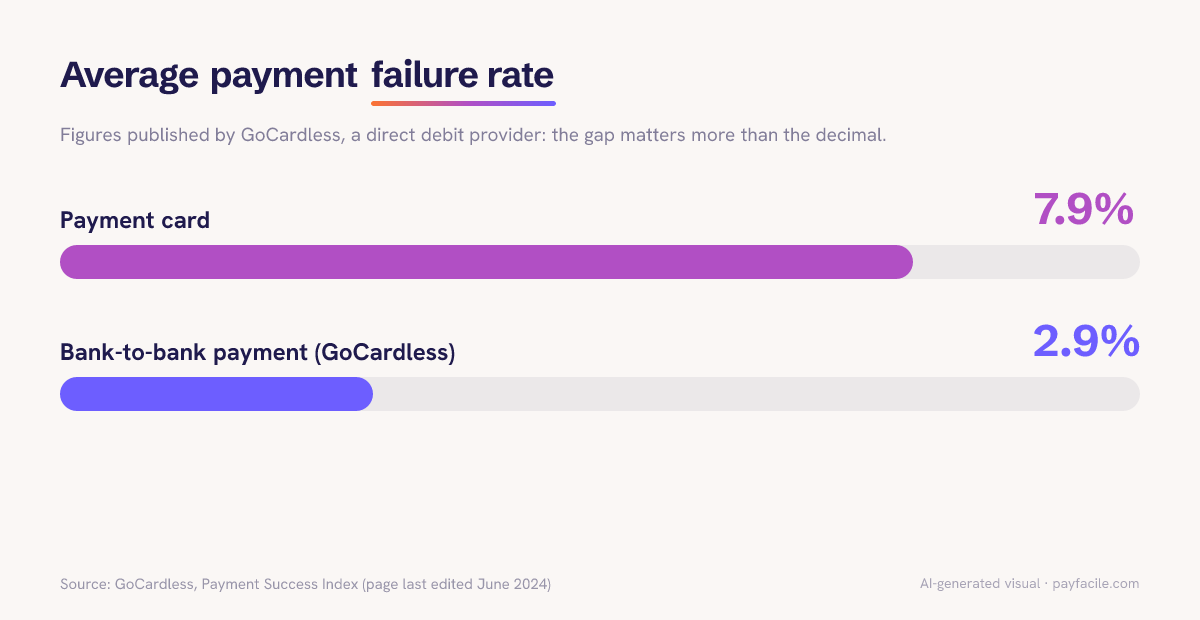
With 3 failures instead of 8, the same book of subscribers keeps an extra €250 a month safe from non-payment. Over a year, that outweighs a lot of acquisition spend. Direct debit has a cost too, though, and you pay it somewhere else in the journey: at signup.
Why a stored card eventually fails
A card saved for a subscription ages. The first charge almost always goes through, because the customer has just typed the details in. Failures come later, for four reasons:
- Expiry. Every card has an end date. If the customer doesn’t update their payment method, the next charge fails.
- Replacement. Lost, stolen or reissued by the bank: the number changes.
- Limit or balance. The charge lands on a day when the spending limit is reached or the account is empty.
- Issuer decline. The bank can block a charge it finds unusual, for example after a price change.
The first two causes can be partly fixed. Stripe offers a card account updater and network tokens, which let a charge go through even when the card details have changed (Stripe announcement). Not every bank takes part, and neither tool helps with limits or fraud declines. For those, you’re left with retries and a message to the customer.
In month one, the card almost always works. The risk grows with each subscriber’s tenure, which means with the customers who are worth the most to you.
What SEPA Direct Debit fixes, and what it doesn’t
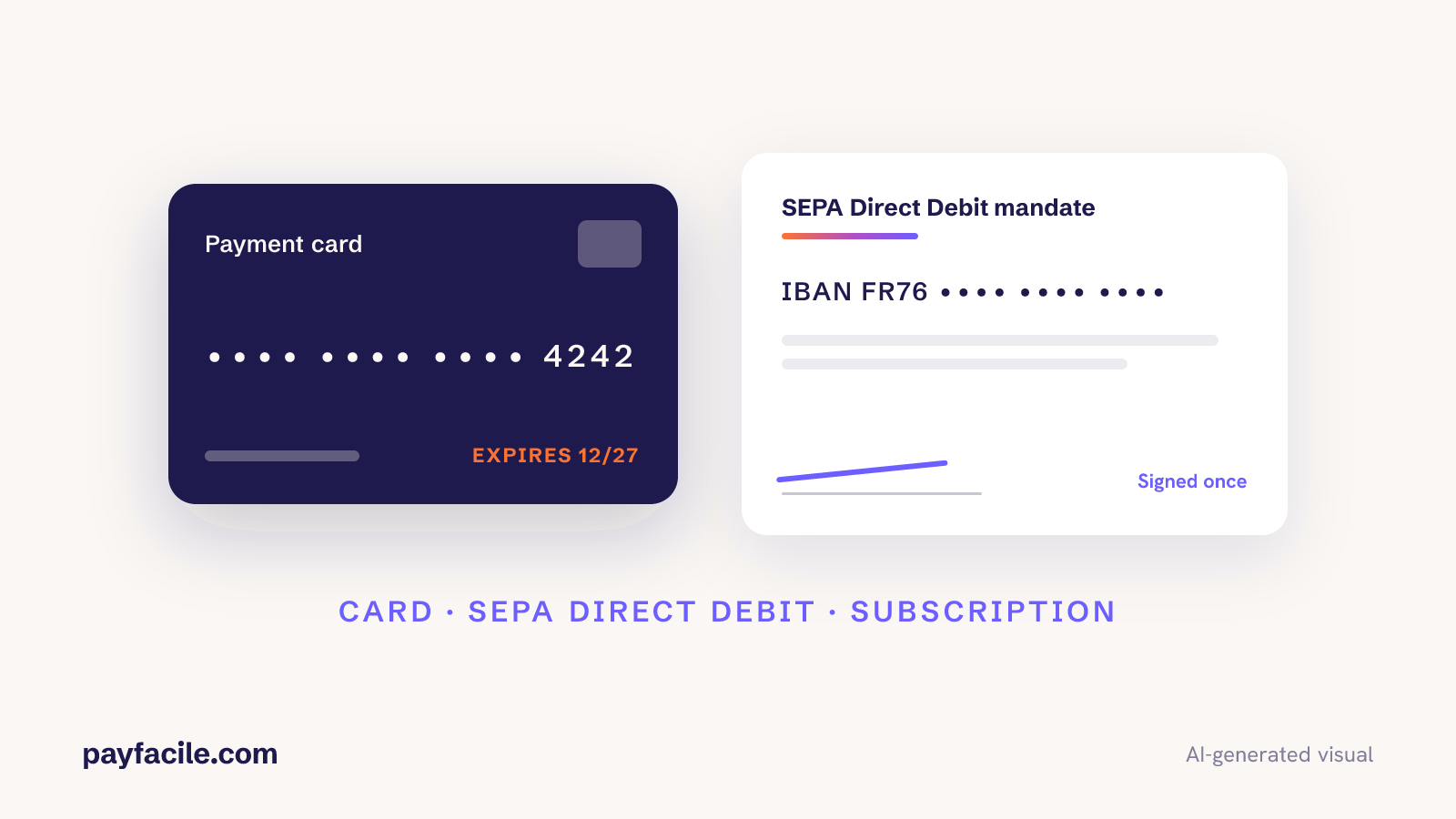
An IBAN doesn’t expire. The customer signs a mandate once, and you collect from their account on every due date without them doing anything else. There’s no card end date, no number that changes after a theft, and no card spending limit. That explains most of the gap.
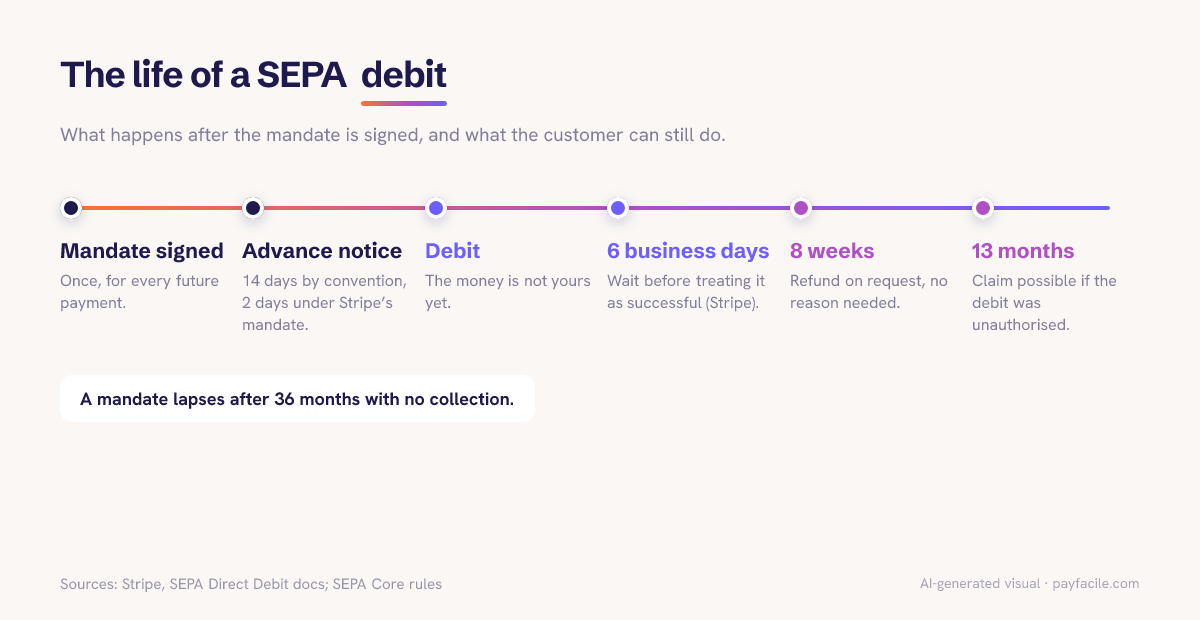
One point is often misread: a mandate is not “valid for 36 months”. It stays valid as long as you use it, and it lapses after 36 months with no collection at all. For an active monthly subscription, that never comes up. For a former customer who returns after three years, you need a new mandate.
When a direct debit still fails
- Insufficient funds (return code AM04). This is the main cause by far: in its UK direct debit data, GoCardless puts it at more than 80% of failures (source).
- Mandate cancelled by the customer through their bank. GoCardless estimates this at around 15% of failures.
- Account closed (AC04), often after a change of bank.
- IBAN mistyped at signup. The first collection is rejected.
The timings to know before you choose
A direct debit isn’t confirmed instantly. Stripe says to wait at least 6 business days before treating a SEPA Direct Debit payment as successful (Stripe docs). With GoCardless, allow 3 to 4 business days from payment creation to payout. During that window, the customer’s bank can still reject the debit.
The customer also keeps a strong right. On a SEPA Core debit, they can get a refund with no reason given for 8 weeks, and then for up to 13 months if they claim the debit was unauthorised. Stripe notes that these disputes are final, with no appeal process. For a €20 subscription used every month, the risk stays small. For a service consumed in one go, it deserves some thought.
At signup, cards have a head start
Direct debit fails less, but it asks for more effort at checkout. A French IBAN has 27 characters, and few people know theirs by heart. A card often fills itself in: the browser or the phone offers it, and the customer confirms.
Two kinds of buyer react very differently to that friction:
- The consumer who decides fast on a small amount. Every extra field is a chance to leave. Cards convert better here.
- The business buyer committing for a year. They read the terms, they already give their IBAN to suppliers, and a mandate doesn’t surprise them.
So the payment method moves the friction around. A card pushes it into the following months, as failures. Direct debit concentrates it on the payment page, once.
I couldn’t find a solid public figure for the signup conversion gap between card and IBAN. The studies out there look at cart abandonment in general. If that number matters for your offer, measure it on your own page.
Four questions to help you choose
- How much does the subscription cost? Under €30 a month, a failure costs little and typing an IBAN weighs a lot: a card is often enough. Above €100 a month, every failure hurts, and direct debit quickly pays for itself.
- Who pays? A consumer has their card to hand. A business, an association or a long-standing member is usually happy to sign a mandate.
- How long is the commitment? The longer it runs, the more likely the card is to expire along the way.
- Does the customer need access straight away? A card confirms the payment immediately. With direct debit, the money arrives days later: if you open access before then, you accept a risk of non-payment on the first instalment.
My view, and it’s only mine: above €50 a month in B2B, offering cards alone means accepting failures you could avoid.
Offer both without making people hesitate
Showing card and direct debit side by side widens your audience. The risk is hesitation: two options presented as equals make the customer think about something they don’t care about.
- Put one option forward. Pick the one that suits your model and say why in a single line, for example “Automatic payment, nothing to update”.
- Give a concrete reason to choose direct debit, if your margin allows: a free month on an annual plan, or no setup fee. Run the numbers first: the discount has to cost less than the failures it prevents.
- Test the display order for a few weeks, and track two numbers: the signup rate and the failure rate at three months. If you only watch the first one, cards will always win.
Recovering a failed payment: cards and direct debit need different handling
A failed payment isn’t a lost customer yet. According to GoCardless, a single retry recovers 32% of the payments that originally failed, on average (source). What works depends on the payment method.
On cards: move fast, with an update link
The customer can fix it themselves in a minute. Email them the same day with a direct link to update their card, then follow up a few days later. For retries, Stripe turns on Smart Retries by default for new accounts: up to 8 attempts within 2 weeks, timed by a model (Stripe docs). A retry is pointless on a card reported lost or stolen: only a new card solves that.
On direct debit: fewer retries, more patience
Stripe caps SEPA Direct Debit retries at 2, within 30 days of the first attempt. The customer must be notified before each debit: the convention is 14 calendar days’ notice, which the mandate can shorten (Stripe’s mandate allows 2 days). Since the main cause is insufficient funds, a retry just after the customer’s payday has a good chance of going through. After a second failure, offer card payment as a fallback.
Either way, what brings the money back is a clear message, sent early, that asks for one action.
With PayFacile: card, direct debit, or both
On PayFacile, you connect Stripe for cards, GoCardless for SEPA Direct Debit, or both, without writing code. Your customer then chooses how to pay. We compare the two gateways in detail in Stripe or GoCardless.
When a payment fails, your customer and you both get an email the same day: that setting is on by default. The “Payment failed: dunning sequence” workflow template goes further. It sends a reminder after 3 days, a final warning after 7 days, then notifies you, and it stops as soon as the customer pays or updates their card. The template starts switched off: turn it on from your workflows.
See how PayFacile can help
Frequently Asked Questions
- How does the SEPA Direct Debit failure rate compare with cards?
- According to figures published by GoCardless, cards have an average failure rate of 7.9%, against 2.9% for bank-to-bank payments such as direct debit. The figures come from a direct debit provider, so the gap is real, but measure its exact size on your own business.
- How long does a SEPA Direct Debit mandate stay valid?
- A SEPA Direct Debit mandate stays valid as long as it is used. It lapses after 36 months with no collection. For an active subscription collected every month, the mandate does not expire on its own.
- Can a customer get a SEPA Direct Debit refunded?
- Yes. On a SEPA Core debit, the customer can get a refund with no reason given for 8 weeks after the debit. After that, they can claim for up to 13 months if they say the debit was not authorised.
- How long does it take to collect a SEPA Direct Debit?
- Several business days. Stripe recommends waiting at least 6 business days before treating a SEPA Direct Debit payment as successful. GoCardless states 3 to 4 business days from payment creation to payout.
- Should I offer both card and SEPA Direct Debit on the same subscription?
- Often, yes. For a subscription, cards convert better at signup and SEPA Direct Debit fails less afterwards. Offer both and put forward the one that fits your price and your customers.
Increase Your Sales Potential
Automate and grow your e-commerce business with ease.