In this article
- Selling training in France: what you sell and who pays decide the rules
- Case A, an individual pays: the contract is signed before any payment
- Case A, an individual pays: nothing for 10 days, then 30% of the price at most
- Case A sold online: a 10-day or a 14-day withdrawal period?
- Case A: what a training provider risks since 27 June 2026
- Case A with PayFacile: a subscription that stops by itself, after a free trial
- Case B, a company pays: a « convention », with no 10-day period and no 30% cap
- Case C: training funded by the CPF, an OPCO, France Travail or a region
- Case D, a course with no professional objective: 14 days to withdraw, and payment at checkout
- Case D with PayFacile: the right checkbox for what you sell
- Professional or personal course: how to tell case A from case D
Selling training in France: what you sell and who pays decide the rules
Up to date as of 19 November 2026.
This is French law. It applies to you if you sell training from France, as a trainer, coach or course creator, to private individuals or to companies.
An employee who pays for their own training out of pocket. An influencer selling “Find clients on Instagram as a freelancer”. A company training its team. A guitar course on video. Four sales of “training”, three payment regimes, and the first two follow exactly the same rules.
The payment rules of the French Labour Code (Code du travail) cover « formation professionnelle », meaning vocational training. The Code defines a training action as “a learning path that leads to a professional objective” (« un parcours pédagogique permettant d’atteindre un objectif professionnel »), which “can be delivered wholly or partly at a distance” (article L6313-2). In a classroom or online, same regime. Neither the word “training”, nor the seller’s status, nor the number of your « déclaration d’activité » (the activity declaration every training provider files with the French administration) decides. What you sell, and who pays, does.
- Case A, an individual pays alone for training with a professional objective: a contract signed before any payment, nothing collected for 10 days, then 30% of the price at most, and the balance as the training goes on.
- Case B, a company pays: a « convention » (an agreement signed with the buyer), with no 10-day period and no 30% cap.
- Case C, the CPF (personal training account), an OPCO (an industry training fund), France Travail (the public employment service) or a region funds it: Qualiopi certification, and their own purchasing channels.
- Case D, a course with no professional objective (cooking, guitar, yoga for yourself): the French Consumer Code (Code de la consommation), with 14 days to withdraw online and the right to take payment at checkout.
Training an employee who pays for it themselves? Case A. Being an employee changes nothing: the payer is what counts. If their employer pays, it’s case B. If they use their CPF, case C.
An influencer selling an online course? If your course has a professional objective (finding clients as a freelancer, becoming a community manager) and an individual pays for it alone, you’re in case A, like any « organisme de formation » (training provider), activity declaration included. No declaration number? That doesn’t take you out of scope: not having filed it is a breach in itself.
Case A, an individual pays: the contract is signed before any payment
Case A is a person who “undertakes training, individually and at their own expense” (L6353-3): an employee training outside their employer and outside the CPF, a jobseeker, someone changing careers, the buyer of an online course aimed at a profession. This client is also a consumer: both codes apply at once.
This contract, the « contrat de formation professionnelle », is signed “before the trainee’s final enrolment and any payment of fees” (L6353-3). On pain of nullity (« à peine de nullité »), it must state the programme and duration, the required level, the training conditions (remote part included), the trainers’ credentials and, above all, the payment terms and the financial conditions if the trainee drops out (L6353-4). Before enrolment, you also hand over a document that gives, among other things, the objectives, the schedule, the internal rules, “the rates, the payment terms” and the conditions if the trainee drops out (L6353-8).
If the trainee stops because of force majeure that is “duly recognised” (« dûment reconnue »), you keep only the pro rata share of the sessions delivered, with no cancellation fee or compensation (L6353-7). If they drop out for another reason, your contract sets the financial conditions. And if you’re the one who fails to deliver all or part of the training, you refund “the sums wrongly received as a result” (L6354-1).
Case A, an individual pays: nothing for 10 days, then 30% of the price at most
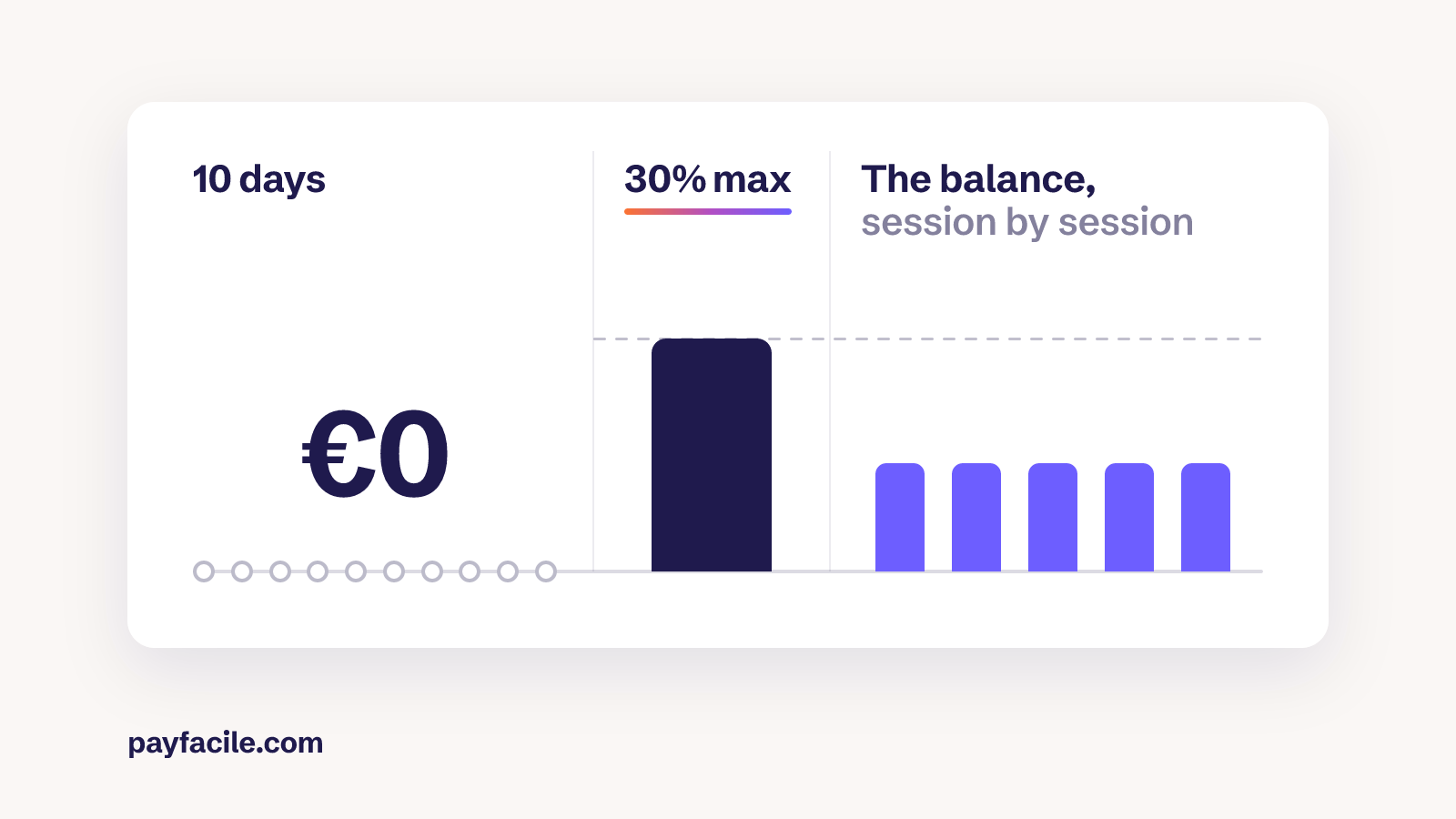
The trainee has 10 days from signing the contract to withdraw, by registered letter with acknowledgement of receipt (L6353-5). That’s the « délai de rétractation », the withdrawal period. During it, “no sum may be demanded from the trainee” (« aucune somme ne peut être exigée du stagiaire », L6353-6): no deposit, no file fee, no enrolment fee. These rules haven’t changed since 1 May 2008. The 14 days you come across elsewhere come from the Consumer Code (see online sales, just below).
The direct consequence: a monthly subscription that takes the first instalment on the day of purchase breaks the rule. So does a one-off payment at checkout.
“At the end of this period, no sum greater than 30% of the agreed price may be paid” (« Il ne peut être payé à l’expiration de ce délai une somme supérieure à 30 % du prix convenu », L6353-6). For a €1,200 course:
- in 3 equal parts, the first payment is €400, or 33.3% of the price: that’s above the cap;
- in 4 equal parts, it’s €300, or 25%: that’s below it;
- in 3 unequal parts, €360 (30%) then €420 and €420 as the training goes on, you stay within the text.
So “pay in 3 instalments” in equal parts doesn’t work: plan on at least 4 payments.
The balance “is paid in instalments as the training action progresses” (« donne lieu à échelonnement des paiements au fur et à mesure du déroulement de l’action de formation »). The text sets neither the number of instalments, nor their amount, nor their dates, and says nothing about payments after the training ends. Write your schedule into the contract, as the Ministry of Labour’s model contract (January 2021) does, tie each payment to a stage of the course, and make the last one fall before the end.
Case A sold online: a 10-day or a 14-day withdrawal period?
For a service bought at a distance, the Consumer Code gives the client at least 14 calendar days to withdraw, from the day after the contract is signed, using a form or any other written statement. The seller can’t require a registered letter (service-public.gouv.fr). None of the exceptions on that official sheet covers training, and it even cites an online “coaching” subscription.
Both periods exist, and no text, court decision or ministerial answer we’ve read says how they fit together. The Ministry of Labour’s model contract applies 14 days to a contract made at a distance. That model doesn’t have the force of law; it’s one administration’s reading.
Our view: for an online sale, collect nothing before the 14 days are over, and accept any clear written statement of withdrawal, without demanding a registered letter. You respect both texts at once, for a few days less of cash flow.
And the box that waives the right of withdrawal, the one buyers tick to access digital content straight away? The Labour Code provides no waiver of the 10-day period or of the ban on collecting payment: ticking that box doesn’t lift the rule in L6353-6.
Case A: what a training provider risks since 27 June 2026
Qualiopi, the French quality certification for training providers, isn’t required when an individual pays alone (L6316-1), and being certified changes nothing in the payment rules. The activity declaration, on the other hand, must be filed from the first contract (L6351-1), and not having filed it is in itself a breach that can be fined.
Law no. 2026-534 of 25 June 2026, in its article 70, repealed the criminal penalties in articles L6355-1 to L6355-23 of the Labour Code. It has been in force since 27 June 2026: any guide that still cites those criminal penalties is out of date. Since then, the administration can send you a warning or impose an administrative fine for a breach of, among others, the activity declaration, the contract or the payment rules (L6356-1). The fine goes up to €4,000 per breach. It doubles for a new breach of the same kind within 2 years of a fine, and rises by 50% within the year following a warning (L6356-2).
Heavier than the fine: your activity declaration. Its registration is cancelled when an inspection finds that one of the chapter’s rules “relating to the delivery of training actions” isn’t met, and the payment rules are among them (L6351-4). So cancellation is possible for collecting payment too early. And a contract missing the mandatory terms is void.
Case A with PayFacile: a subscription that stops by itself, after a free trial
On PayFacile, you can sell your training as a monthly subscription that stops automatically after the number of months you choose. Your clients pay by card or by SEPA direct debit, through the payment account you connect.
You can add a free trial period: the first payment is only taken at the end of it. Choose a length that covers the whole withdrawal period, with a few days’ margin. Count in weeks, 3 weeks for instance, rather than in days. Your client sees the label « Période d’essai » (“Trial period” on the English version of your shop), so state in the contract what those weeks without payment correspond to.
You set the amount of each monthly instalment. With equal instalments, you need at least four for the first one to stay under 30% of the price. Choose a number of months that fits within the length of your training, since the balance is paid as the sessions go on.
Don’t add a file fee or a setup fee on the first payment: either would fall during the period when nothing can be demanded. And don’t sell case A training as a one-off payment, because your client would pay at checkout, so during that same period.
On your shop, your clients find a « Renoncer au contrat ici » link (“Withdraw from the contract here” in English) to withdraw online, and you get an email for each withdrawal. Stopping the subscription and issuing the refund remain up to you. This link serves the 14-day withdrawal right of the Consumer Code. The Labour Code’s 10 days run from the signing of the contract, by registered letter: accept a withdrawal sent either way.
The training contract stays your responsibility: have it signed before enrolment and before any payment.
The default terms of sale offered on your shop don’t stand in for a training contract: they don’t contain its mandatory terms, and they state that payment is due on ordering. For case A, replace them with your own terms, in Settings, under Legal.
Card or direct debit for the monthly instalments? We compare the two in our article on SEPA direct debit and card payments for subscriptions.
Case B, a company pays: a « convention », with no 10-day period and no 30% cap
A company buys the training for an employee, a director pays for it with their company’s money, an association trains its volunteers. The document to sign becomes a « convention » between the buyer and you, “on terms set by decree” (L6353-1). That decree sets what the convention contains: start from it before writing yours.
The 10 days and the 30% follow the contract signed by an individual, so they don’t apply to the convention. No 14-day right of withdrawal either: it protects consumers, and a company buying for its business isn’t one. The activity declaration, though, stays mandatory whoever pays, and not having filed it is still sanctioned (L6356-1).
On PayFacile, you can restrict a training course to business buyers: to the question “Who can buy this product?”, choose “Businesses only”. At checkout, your client enters their company name and billing address and, if they wish, their SIREN (French company number) and VAT number.
You can also create the order yourself from your dashboard and send your client the link, so they confirm it and pay.
Your client finds their invoices in their customer account.
Case C: training funded by the CPF, an OPCO, France Travail or a region
If the training is funded by the CPF, an OPCO, France Travail or a region, other rules apply on top, including Qualiopi certification (L6316-1), and the purchase goes through their own channels: training paid for with the CPF is booked on Mon compte formation, the official CPF platform.
PayFacile is for collecting what your client, or their company, pays directly.
Case D, a course with no professional objective: 14 days to withdraw, and payment at checkout
Cooking, guitar, yoga, drawing, photography for yourself, personal development. With no professional objective, there’s no training action in the sense of L6313-2. On our reading, these courses therefore fall outside the Labour Code: no contract under article L6353-3, no 10 days, no 30%, no activity declaration. No court decision we’ve read says so in as many words.
That leaves the Consumer Code. For a course bought online, your client has 14 days to withdraw, from the day after the contract is made, using your form or any other written statement, and you refund them within 14 days at the latest (service-public.gouv.fr).
You can take payment at checkout. The ban on receiving any payment for 7 days covers doorstep selling (« démarchage ») and off-premises contracts, and selling online counts as distance selling (service-public.gouv.fr). Online, your client is protected by the refund. No 30% cap, no required instalments: one-off payment, subscription, trial, you choose.
Two exceptions matter for a course. For digital content (videos, modules), the client loses their right if they asked for access before the period ended and waived that right, and if you confirmed that agreement to them. For a service (live sessions, coaching), a client who expressly asked for an early start and then withdraws pays for the part provided; they pay nothing if their request wasn’t recorded on paper or on a durable medium. A service fully performed before the period ends, with their agreement, can no longer be withdrawn from.
Case D with PayFacile: the right checkbox for what you sell
Selling a video course as a one-off payment? On the payment page, your client asks for immediate access and acknowledges losing their right of withdrawal for that content. You can remove this box if you’d rather leave them their 14 days.
Selling live sessions or coaching? Your client can ask for the service to start before the 14 days are over. If they withdraw afterwards, they pay for the part provided up to then.
You can also sell your course as a monthly subscription, with or without a trial period. On a subscription, your client keeps their 14 days to withdraw and can do so online from your shop. Neither box appears on a subscription: if your client withdraws within the 14 days, they get back what they paid and owe nothing for the use. A free trial of 14 days or more, 3 weeks for instance, saves you refunding a first month.
Professional or personal course: how to tell case A from case D
A course to “build your confidence” or “dare to speak up”: career, or hobby? No text draws the line course by course. The test is the professional objective.
Ask yourself one question: is your client buying this course for their job, or for themselves? If it’s for their job, apply the « formation professionnelle » rules.
What counts is what your sales page promises, not the label. If it promises clients, a profession or an income, that’s a strong sign of a professional objective, even if you call it a hobby.
If your client is an auto-entrepreneur (a French micro-entrepreneur), the cautious route is to apply the same rules as for an individual.
When in doubt, apply the case A rules. They only cost you time before you get paid. Ignoring them exposes you to the fine, and to the possible loss of your activity declaration.
See how PayFacile can help
Frequently Asked Questions
- Do the French training payment rules apply to an employee who pays for their own training?
- Yes. As of 19 November 2026, an employee in France who pays alone for training with a professional objective, without going through their employer or their CPF (personal training account), falls under the contract of article L6353-3 of the French Labour Code (Code du travail): a contract signed before any payment, nothing collected for 10 days, then 30% of the price at most, and the balance as the training goes on. Being an employee changes nothing: the payer is what counts. If the employer pays, a « convention » (an agreement with the company) replaces the contract (article L6353-1).
- Do the French training rules apply to an influencer selling an online course?
- Yes, if the course has a professional objective and an individual pays for it alone. As of 19 November 2026, the French Labour Code doesn’t make these rules depend on the seller’s status or on the online format: a contract before any payment, 10 days without collecting anything, then 30% of the price at most, and a « déclaration d’activité » (activity declaration) from the first contract (articles L6353-3, L6353-6 and L6351-1). For a course with no professional objective, our reading is that only the French Consumer Code applies.
- What if a company pays for the training in France?
- As of 19 November 2026, when a company buys training in France, the training provider signs a « convention » with it, an agreement whose content is set by decree (article L6353-1 of the French Labour Code). The 10-day period and the 30% cap don’t apply. Nor does the 14-day right of withdrawal of the French Consumer Code, since a company buying for its business isn’t a consumer.
- How much can you collect when an individual pays for training in France, and can they pay in 3 instalments?
- As of 19 November 2026, when an individual pays alone for « formation professionnelle » (vocational training) in France: nothing for the 10 days after the contract is signed, file fees included, then 30% of the price at most, and the balance as the training goes on (article L6353-6 of the French Labour Code). For €1,200, three equal parts of €400 exceed the cap (33.3%). Four parts of €300 are within it, and so are three unequal parts of €360, €420 and €420.
- What withdrawal period applies to training sold online to an individual in France?
- As of 19 November 2026, for vocational training paid for by an individual, the French Labour Code provides 10 days from the signing of the contract (article L6353-5). Online, the French Consumer Code also provides at least 14 days, and nothing we’ve read says how the two fit together: the cautious route is to collect nothing before the 14 days are over.
- What penalty does a training provider in France face for collecting payment too early?
- As of 19 November 2026, an administrative fine of up to €4,000 per breach, doubled for a repeat breach within 2 years (articles L6356-1 and L6356-2 of the French Labour Code), and the possible cancellation of its « déclaration d’activité » (activity declaration). The law of 25 June 2026, in force since 27 June 2026, repealed the former criminal penalties.
Increase Your Sales Potential
Automate and grow your e-commerce business with ease.