What became mandatory on 1 September 2026
Your large suppliers, your telecom operator, your energy provider now issue their invoices in a structured electronic format. That has been their obligation since 1 September 2026. It is not yours. Yours, if you run an SME, is being able to receive them.
This is French law. The test is not what language you run your business in, or where your shareholders sit: it is whether your company is established in France and assujettie à la TVA, a taxable person for VAT purposes. If that describes your company, everything below applies to you in full.
Two obligations start, and they do not target the same companies.
Receiving concerns everyone. Every business subject to VAT and established in France must be able to receive structured electronic invoices, through an approved platform. There’s no threshold of size, revenue or legal form.
Issuing, for now, concerns only large companies and ETI (entreprises de taille intermédiaire, the mid-size band that sits above SMEs). They issue their invoices in a structured electronic format and send their transaction data to the tax administration. SMEs, very small businesses, micro-entreprises and the self-employed have until 1 September 2027.
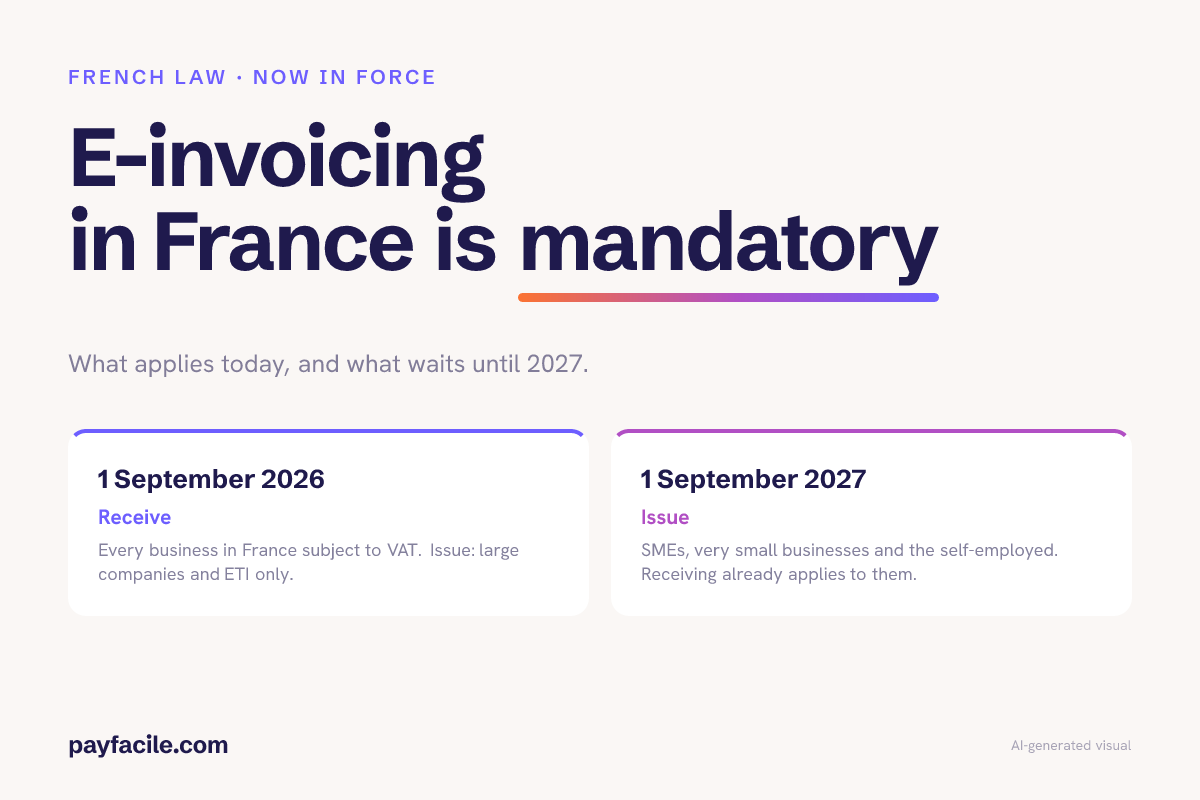
That is the most common confusion on the subject: on that date, only receiving is universal.
The reform requires three standard formats, all of them machine readable:
- Factur-X: a PDF/A-3 that a human can read, carrying an XML file that a machine can read. It is the most widespread format, and the most accessible to small operations.
- UBL (Universal Business Language): an international standard already in use in B2B exchanges.
- CII (Cross Industry Invoice): a UN/CEFACT standard, common in industry and in the European public sector.
A plain PDF emailed to your customer is not an electronic invoice in the sense of the reform. It becomes one only when it carries the structured data the tax administration requires.
What changes is not going digital, which most companies did years ago. It is the structured format, and the trip through a platform the state has approved.
The full timeline: who owes what, and when
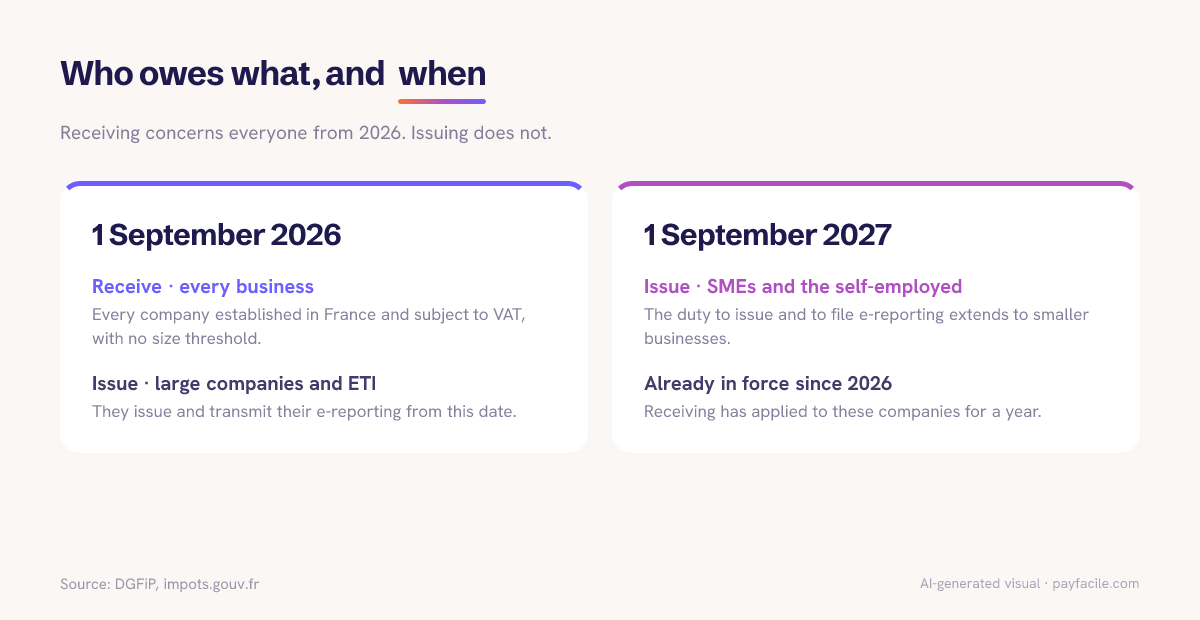
The timeline of the reform comes down to two dates.
1 September 2026
- Receiving: every business subject to VAT. No size exemption.
- Issuing and e-reporting: large companies and ETI.
1 September 2027
- Issuing and e-reporting: SMEs, very small businesses, micro-entreprises and the self-employed.
The categories follow the classification in décret n° 2008-1354, the French decree that defines company size:
- Large company: at least 5,000 employees, or more than €1.5 billion in revenue and more than €2 billion in balance sheet total.
- ETI: 250 to 4,999 employees, with revenue not exceeding €1.5 billion.
- SME: fewer than 250 employees, with revenue not exceeding €50 million.
One point regularly gets forgotten: auto-entrepreneurs and businesses under the franchise en base de TVA are in scope. They are not redevables, they charge no VAT and remit none, but they are assujettis, taxable persons. The reform targets taxable persons, so they fall inside the perimeter, receiving included. That covers freelancers and auto-entrepreneurs who collect recurring payments.
The timeline has already slipped once. The obligation was originally due to start in July 2024. The postponement was written into a finance act (loi de finances), and it is indeed the September 2026 and September 2027 dates that apply.
If you run an SME, you don’t have to issue anything yet. But you already have to be able to receive.
e-invoicing or e-reporting: which one is yours
The reform rests on two separate pillars. Confusing them produces either duplicates or gaps in what you declare.
e-invoicing, the electronic invoice itself
It covers domestic B2B: transactions between two businesses subject to VAT and established in France. Each invoice has to be issued in one of the three structured formats, then transmitted by an approved platform. It no longer travels straight from you to your customer.
e-reporting, the transmission of data
It covers everything else:
- sales to consumers (B2C);
- international operations: intra-community supplies and acquisitions, exports.
Here there’s no structured invoice per sale. You send the tax administration transaction and payment data, aggregated by day, by VAT rate and by type of operation. The frequency depends on your VAT regime: three times a month, monthly, or every two months. While you are in there, check that your tax profiles reflect the cases you really have.
This distinction decides a great deal, depending on what you sell. An online retailer, a coach or a creator selling almost exclusively to consumers will not produce a Factur-X invoice per sale. Their main obligation is e-reporting, a much lighter load.
Invoices to the public sector (B2G) do not change. They keep going through Chorus Pro, mandatory since 2020.
Start by splitting your revenue between domestic B2B, international B2B and B2C. That split decides which of the two obligations is yours, and in what proportion.
The four new details every invoice must carry
Four pieces of information get added to what your invoices already carry. Nothing is removed: invoice number, date, both parties, description, VAT rates and amounts all stay. French law calls the whole set the mentions obligatoires, and the four new ones come into force at the pace of the issuing calendar: since 1 September 2026 for large companies and ETI, on 1 September 2027 for SMEs, very small businesses and micro-entreprises.
1. Your customer’s SIREN
Nine digits, whenever your customer is a business subject to VAT. It used to be optional. It is now the identifier the tax administration uses to match your invoice against the purchase declared on the other side, and the one your approved platform uses to find your customer’s platform in the directory. Don’t confuse it with the SIRET, which has fourteen digits and designates one site, or with the intra-community VAT number, which starts with FR.
The practical part: ask for it at the point of sale, not at the point of invoicing. A SIREN you chase afterwards is an email, a follow-up, and an invoice sitting still.
2. The delivery address for goods
Only when it differs from the billing address, and only for goods. If you sell services alone, there is nothing here for you. If you ship, your order form has to carry both addresses separately, and so does your invoice.
3. The nature of the transaction
Supply of goods, supply of services, or both. This one is settled by what you sell, not by the invoice in front of you. A trainer who sells a session and a printed workbook issues a mixed invoice, and has to say so.
4. The option for paying VAT on debits
This applies only to businesses that asked the administration for it. It is not automatic: either you took the option or you did not. If you did, the mention has to appear on the invoices concerned. If you are not sure, your expert-comptable knows.
A missing detail has a price, and it was set long ago by article 1737, II of the Code général des impôts, the French tax code: €15 per omission or inaccuracy on an invoice, capped at a quarter of the amount it carries. The four new details fall within its scope. The €50 per invoice not issued in electronic form, which we come to further down, sits at III of the same article and covers something else entirely.
Adding four lines to an invoice template is not the job. Filling them in, on every invoice, without thinking about it, is. And that job happens upstream: in your order form, in your customer record, in your product catalogue. The data has to exist before the invoice is generated, because this time it travels in a structured field, and an empty field cannot be patched with a sentence in the body of the document.
Is there still a free public platform?
No, and it is the change that most articles published before the end of 2024 missed.
The PPF no longer lets you invoice
The Portail Public de Facturation (PPF), the state invoicing portal, was originally meant to provide a minimum issuing and receiving service, free of charge. After the state refocused on the official directory project, that service was dropped. Companies can no longer count on the PPF for their invoicing. Its role now centres on the directory, on the data concentrator, and on collecting VAT and e-reporting information for the DGFiP, the French public finances directorate.
The consequence is direct: there is no free public platform for issuing and receiving. Going through an approved platform is mandatory. The tax administration writes it without ambiguity: only an approved platform is authorised to provide the full set of functions the reform covers, for electronic invoicing and for e-reporting. The original, worth keeping if you go looking on impots.gouv.fr: « Seule une plateforme agréée est habilitée à assurer toutes les fonctionnalités prévues par la réforme en matière de facturation électronique et de e-reporting. »
Don’t confuse the PPF with Chorus Pro. Chorus Pro remains the platform where the public sector receives its supplier invoices, for B2G exchanges.
The plateforme agréée, formerly the PDP
A plateforme agréée (PA), an approved platform, is a private operator registered by the DGFiP after review against a strict set of requirements. Until 2025 it was called a plateforme de dématérialisation partenaire (PDP), and you will still see that acronym everywhere. More than 140 platforms are registered to date. Registrations were first granted provisionally, with confirmation depending on interoperability tests with the public portal and with the other platforms.
An approved platform transmits your invoices and takes care of your e-reporting. It usually adds services on top: automatic reconciliation, API integration with your accounting tool, credit note handling, status tracking.
An OD on its own is not enough
An opérateur de dématérialisation (OD), a dematerialisation operator, is any provider offering dematerialisation services: invoicing tool, accounting software, scanning, point-of-sale software. An OD is not registered and does not appear in the directory. It can neither issue nor receive on your behalf: it has to rely on an approved platform.
The directory, the piece that makes routing possible
The state is building a directory listing every business subject to VAT, with the details of the platform each one has mandated for receiving. That is what lets your supplier’s invoice arrive in the right place. Every business therefore has to designate an approved platform and be listed in the directory, even if it is expecting no electronic invoice at all for the moment.
Choosing an approved platform: five criteria and the prices we found
With more than 140 registered platforms, the choice comes down to five criteria.
- 1. Registration. Check that the vendor appears on the official list the DGFiP publishes on impots.gouv.fr. That is the one non-negotiable point.
- 2. Functionality. A simple invoicing tool, pre-accounting, or full accounting production? What productivity does it give you back, and on which task?
- 3. Getting your data out. Ask how you retrieve your invoices and your history the day you leave. The answer to that question tells you more about a vendor than its security page does.
- 4. Simplicity. Ask for a demo or a trial period. The tool has to suit you and your customers alike.
- 5. Price. Monthly or annual subscription, pricing by invoice volume, and above all: is the cost of electronic invoicing passed on to you or not?
One technical point often decides the rest: the connection between the platform and the tool that produces your invoices. A platform that is not wired into your software will have you fetching supporting documents by hand. Favour a proven API, or a platform built natively into the tool you already use.
Prices recorded on 1 September 2026
The rates below are the ones we recorded at the date of publication. Check the current grid before you sign.
- Pennylane: a micro-entreprise plan at €0, limited to one user and 1,200 invoices a year. Then €7 excl. VAT per month (Starter), €14 (Basique), €24 (Essentiel) and €79 (Premium, with the accounting module). Electronic invoicing is included at no extra cost in every plan, the free one included.
- Sellsy: an approved platform, priced per user with a minimum of two licences. The vendor publishes no public grid and gives its prices on request.
- Axonaut: an approved platform since January 2026, entry price recorded at around €35 excl. VAT per month, everything included, with a discount for an annual commitment.
The advice that comes back from everyone working on the reform: use a single platform rather than several. You centralise your invoices and your data in one place, you get a complete view of your VAT, and you keep your subscription costs down.
A badly fitting tool at €0 costs more in manual corrections than a €25 a month subscription. Judge it on how it fits your business cases, not on the sticker price.
After you send: the four statuses that come back
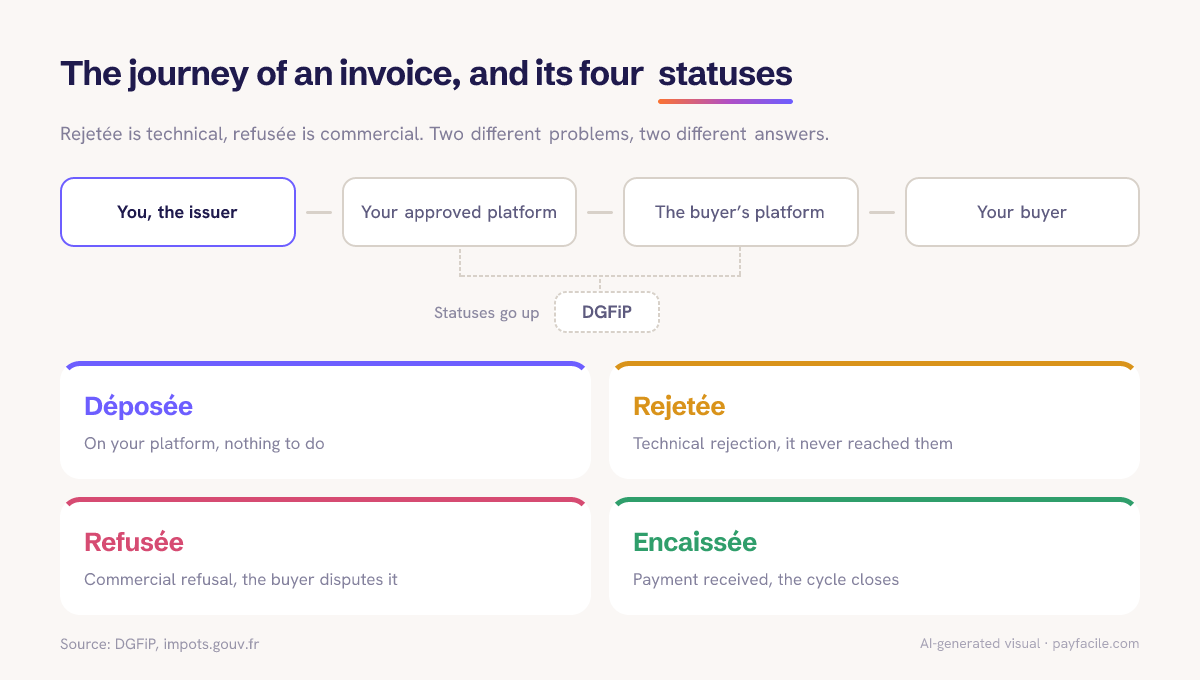
An invoice between two French businesses no longer goes from your mailbox to your customer’s. You deposit it on your approved platform, that platform routes it to the buyer’s, and every leg of the trip sends back an acknowledgement. Those acknowledgements are called statuses. Four of them are mandatory and go up to the DGFiP.
- Déposée, deposited. Your invoice has reached your approved platform. The cycle starts, you have issued, nothing to do.
- Rejetée, rejected. A technical rejection by a platform: bad format, a missing mandatory mention, a customer identifier the directory cannot find.
- Refusée, refused. A commercial refusal by your buyer. The file is fine; what they dispute is the substance.
- Encaissée, paid in. You have received the money. This is the status that closes the cycle, and it is called Encaissée, not payée.
Rejected and refused are not the same problem
In English the two words sit close enough to being synonyms that it’s easy to skim past the difference. In the reform they are two different situations, and a different person has to act.
An invoice marked rejetée never arrived. Your customer has not seen it, it does not exist for them, and their payment clock has not started. The problem is on your side and it is mechanical: fix the offending field, deposit again, and it is closed without anyone having to talk about it.
An invoice marked refusée did arrive, was read, and is being contested: a quantity, a price, work that did not go as agreed. There is no file to fix. There is a call to make, and then, depending on how it goes, a credit note to issue and a new invoice to send. Treating a refusal as a rejection burns weeks hunting for a format error where there is a disagreement.
Those four are joined by recommended statuses, which your platform will show under their French names too (mise à disposition, prise en charge, approuvée, en litige, suspendue), and by free statuses each platform defines for itself. Approuvée, approved, belongs to the recommended set: it is not mandatory. Don’t build your cash forecast on a status some of your customers will never send.
For the first time you’ll know where an invoice stands without calling anyone. That’s where shorter payment times will come from, far more than from any automated reminder.
Subscriptions, SaaS and recurring payments: where it gets hard
Companies that bill by subscription run into constraints the reform was not designed to make easy. Where a tradesperson issues a few dozen invoices a month, a SaaS vendor or a training platform generates hundreds of them, automatically, with pro rata amounts and plan changes mid-cycle.
Three friction points
- Credit notes. Every partial refund, every plan change triggers a credit note. Each of those documents follows the same circuit as the invoice: structured format, transmission by an approved platform. Handling them by hand stops being realistic past a handful a month.
- Multiple currencies. If you bill in dollars or in pounds, the conversion into euros has to appear in the structured flow. Your invoicing engine has to put that data in without you touching it.
- Intra-community VAT. B2B sales into the European Union and B2C sales that fall under the OSS one-stop shop are not subject to domestic electronic invoicing, but they do fall under e-reporting. Mixing up the two regimes exposes you to duplicates or to omissions.
If you sell to consumers, your load is lighter
You won’t have to produce a Factur-X invoice per sale. Your obligation is the e-reporting of your transaction data. It is a genuine load, but far lighter than the words “electronic invoice” lead you to fear.
With PayFacile, compliance comes included
You sell, you get paid, you stay compliant. That has been the PayFacile promise from day one: your time goes to your business, not to administrative plumbing.
Today your invoices are already generated automatically on every sale and you can make them your own. Tomorrow they will meet the reform without you lifting a finger.
- The right format, automatically. Your invoices will go out in Factur-X, one of the three formats the tax administration accepts. To you and to your customers, they will look exactly the same.
- Your legal identifiers, with no rekeying. Your SIREN and your VAT number: we fetch them and we check them for you.
- Checkout that stays simple. Your buyers only see the fields that genuinely apply to them, business or private individual.
- Transmission through an approved platform, included. Your invoices leave through the official channel, and your sales data is filed the way the law requires. Nothing for you to configure.
All of it will be in place before the end of 2026. We will move in stages, starting with pilot sellers, so that everything is proven well before the deadline that applies to you. When the day comes, the switch will be a single setting in your account.
One thing will stay on your side: designating your own approved platform so you can receive your suppliers’ invoices. That particular obligation has been in force since 1 September 2026, it applies to every business, and you settle it once. PayFacile takes care of everything else.
In the meantime, you can already automate your invoicing and your payment reminders.
For a subscription business, compliance is not settled in the accounting software. It is settled in the billing engine. That is the piece that has to speak the language of the approved platforms.
What it costs: €50 per invoice, €500 per missed transmission
The fines have changed. The penalty went from €15 to €50 per invoice, and from €250 to €500 per missing e-reporting transmission. If you’ve read a lower figure somewhere else, it dates from the previous version of the text.
The obligation to issue in electronic format is set by article 289 bis of the Code général des impôts, the French tax code. The penalty itself sits in article 1737, III: a fine of €50 per invoice not issued in electronic form, with the total capped at €15,000 per calendar year.
For e-reporting, article 1788 D sets a fine of €500 per transmission not made, capped in the same way at €15,000 per calendar year. An approved platform that fails its own transmission obligations faces €750 per transmission, up to €100,000.
One point often goes unmentioned, and it matters: the first infringement in a four-year period is not penalised if it is put right spontaneously, or within thirty days of a first request from the administration. The reform does allow for some tolerance on the way in.
The fine is not the real stake
The main risk comes from automated data cross-checking. Every invoice transmitted by an approved platform feeds straight into DGFiP systems. In practice:
- matching issuer against receiver: a gap between the VAT you declare and the invoices received by your customers raises a flag;
- identifier checks: the administration can verify that the issuing SIREN exists and corresponds to a real activity;
- deadline checks: any delay in transmission becomes visible immediately.
This cross-checking is the point: fighting VAT fraud is one of the four objectives the government has set out for the reform. You no longer invoice in your own corner, you invoice inside a system that compares.
Where to start if you have done nothing yet
If you are starting from zero, the order of operations counts for more than speed.
- Step 1. Designate an approved platform and get yourself listed in the directory. It is the minimum action and the most urgent one, since it is the thing that lets you receive at all.
- Step 2. Map your invoicing flows. Identify every channel that produces data to transmit: invoicing tool, point-of-sale software, online shop, payment platform. Count your monthly volume, note your formats, and split your revenue between domestic B2B, international B2B and B2C.
- Step 3. Go through your internal processes. Approval circuits, accounting treatment, archiving, and the special cases: self-billing, intra-group, factoring, down payments, credit notes.
- Step 4. Check that your tools interoperate. Your vendor should have published its roadmap by now. If your tool has nothing planned for connecting to an approved platform, you’ll have to change it.
- Step 5. Set yourself figures to hit. Estimate what processing one invoice costs you as things stand, compare it with automated processing, and multiply the gap by your volume. That calculation is what turns a regulatory constraint into a project worth running.
Those five steps cover your organisation. For what has to change inside the sales themselves, customer data, catalogue, payments, work through the checklist to get your sales ready before September 2027.
Don’t copy a peer’s method: every company is a special case. Your accountant, your expert-comptable, is best placed to fill in the rest.
What you gain by not waiting
The state puts the expected gains for very small businesses and SMEs at €4.5 billion a year once the reform is fully in place. Take it for what it is: an administration estimate, over a horizon nobody has specified. The gain you can check for yourself is smaller and more certain: the time you spend rekeying, chasing and filing.
For an SME, the year ahead is not a grace period. It is the window to choose a tool, test it and break it in before the obligation to issue applies, on 1 September 2027, without turning it into an emergency in August.
See how PayFacile can help
Frequently Asked Questions
- Is electronic invoicing mandatory for every company in France?
- Not on the same terms for everyone. Since 1 September 2026, every business subject to VAT and established in France has had to be able to receive electronic invoices through an approved platform, whatever its size. The obligation to issue, on that date, applies only to large companies and ETI. SMEs, very small businesses, micro-entreprises and the self-employed will have to issue from 1 September 2027.
- Does it apply to a micro-entreprise under the franchise en base de TVA?
- Yes. The reform targets businesses that are assujetties to VAT, taxable persons, not only those liable to charge it. A micro-entreprise under the franchise en base is a taxable person even though it invoices no VAT. It has therefore had to be able to receive electronic invoices since 1 September 2026, and it will have to issue them from 1 September 2027.
- Can you still email a PDF invoice?
- Not between taxable businesses established in France, once the issuer is subject to the issuing obligation. A plain PDF, even electronically signed, is not an electronic invoice in the sense of the reform: it takes a structured format (Factur-X, UBL or CII) transmitted by an approved platform. Sales to consumers are not covered by that formalism, but they do fall under e-reporting.
- Is there a free platform for issuing electronic invoices?
- No. The free issuing and receiving service that the Portail Public de Facturation was meant to offer was dropped at the end of 2024, when the state refocused on the directory. There is no free public platform for invoicing today: going through an approved platform (plateforme agréée) is mandatory. The PPF keeps a role as directory, as data concentrator and as collector of VAT information. Some private vendors do offer a free plan.
- What is the difference between e-invoicing and e-reporting?
- e-invoicing is the electronic invoice itself, for domestic B2B between French taxable businesses: each invoice is issued in a structured format and transmitted by an approved platform. e-reporting is the transmission of transaction and payment data to the tax administration, for sales to consumers and for international operations. In that second case there is no structured invoice per sale, but data aggregated by day, by VAT rate and by type of operation.
- What is a plateforme agréée, the former PDP?
- A plateforme agréée (PA), an approved platform, is a private operator registered by the DGFiP after review against a strict set of requirements. Until 2025 it was called a plateforme de dématérialisation partenaire (PDP), and the two acronyms mean the same thing. It alone is authorised to transmit your invoices and your e-reporting data. More than 140 platforms are registered, and the official list is published on impots.gouv.fr.
- What is the difference between a plateforme agréée (PA) and an opérateur de dématérialisation (OD)?
- A plateforme agréée is registered by the DGFiP and appears in the directory: it can issue and receive your invoices and transmit your e-reporting. An opérateur de dématérialisation is not. An OD can produce your invoices in the right format, but it can neither issue them nor receive them for you: it has to rely on an approved platform. An OD on its own is therefore not enough to be compliant.
- What is the fine for not complying with electronic invoicing?
- Article 1737, III of the Code général des impôts sets a fine of €50 per invoice not issued in electronic form, capped at €15,000 per calendar year. Article 1788 D sets a fine of €500 per e-reporting transmission not made, also capped at €15,000 per calendar year. A first infringement in a four-year period is not penalised if it is put right spontaneously or within thirty days of a first request from the administration.
- Where do you start to become compliant?
- Designate an approved platform and get yourself listed in the directory. That is the minimum action, and it is what makes you able to receive electronic invoices. The official list of approved platforms is published by the DGFiP on impots.gouv.fr. Then map your invoicing flows to work out which of the two obligations, e-invoicing or e-reporting, really weighs on your business.
- What are the new mandatory details on a French invoice in 2026?
- Four details are added to the ones already required: the customer’s SIREN when that customer is subject to VAT, the delivery address for goods when it differs from the billing address, the nature of the transaction (supply of goods, supply of services or a mixed operation) and the option for paying VAT on debits when the seller has taken it. They do not replace the existing mentions, they come on top of them. They apply at the pace of the issuing calendar: since 1 September 2026 for large companies and ETI, from 1 September 2027 for SMEs, very small businesses and micro-entreprises.
- What is the difference between a rejected and a refused e-invoice?
- An invoice marked rejetée was turned away for a technical reason, by an approved platform: bad format, a missing mandatory mention, a customer identifier the directory cannot find. Your customer never received it and their payment clock has not started; you fix the offending field and deposit it again. An invoice marked refusée was turned down for a commercial reason, by the buyer, who disputes a quantity, a price or the service itself. There is nothing to fix in the file: it is settled by talking to the customer, then, if that is where it lands, by a credit note and a new invoice.
Increase Your Sales Potential
Automate and grow your e-commerce business with ease.